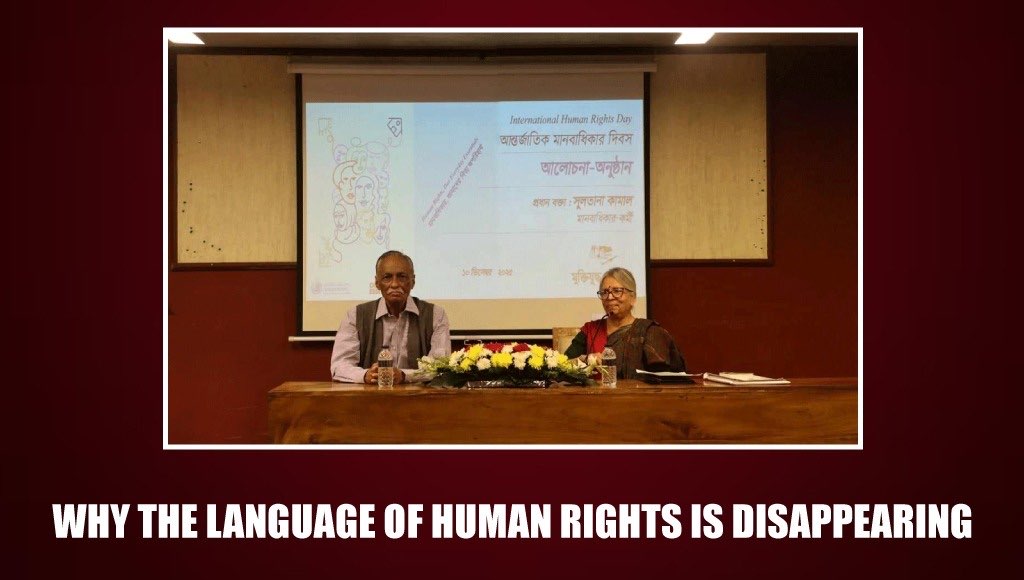

Sultana Kamal’s admission is, in fact, a precise snapshot of Bangladesh’s current reality. When someone who has spent a lifetime speaking about human rights says she now hesitates to do so, it shows just how deep the crisis has become. The real question is: who is responsible for this hesitation? Who created the situation that led to it?
Whatever name one gives to what happened in July 2024, the core truth is that an elected government was forcibly removed. What followed was a seizure of power backed by foreign funding, extremist groups, and military support. Since then, it has become essential to ask what the real state of human rights looks like.
What has happened over the past few months under Muhammad Yunus and his so-called government has put every concept of human rights into question. Where there was once a legal framework, there is now uncertainty. Where people once had freedom of movement, there is now fear. Minority communities that have lived in this country for centuries now worry daily about their safety.
When a man who received the Nobel Prize for working with the poor comes to power illegally and accepts a system that tramples on the basic rights of ordinary people, it is not only disappointing but dangerously alarming. A figure praised for microcredit now presides over a country where violence spreads, minority homes are burned, and businesses are looted. In that context, where does his moral standing really lie?
Sultana Kamal is right that no one can be arrested without a specific reason. But how many people have been picked up in recent months without any reasonable grounds? How many have disappeared? How many families still do not know where their loved ones are? And all this is happening under the leadership of someone who has long presented himself as a defender of human rights.
The constitution speaks of equality, human dignity, and justice. Yet there is an active attempt to discard that very constitution. When an illegal government remains in power, the constitution loses all meaning. That is exactly what is happening now. The administration run by Yunus and his associates did not come to power through any democratic process. They were not elected by the people and have no accountability to them.
Another point must be made very clear. When change is driven by foreign funding, it is never truly for the welfare of the country’s people. Such funding comes with specific interests and agendas. To implement those agendas, a weak and controllable government is required. Yunus’s regime is playing precisely that role. Instead of prioritizing national interests, the wishes of foreign patrons have become the main deciding factor.
History shows how dangerous it is for human rights when change is brought about with the support of Islamist militant groups. These groups have no interest in protecting human rights. Their goal is to establish rule through fear, erase dissent, and eliminate minorities. Violence is their primary tool. What Bangladesh has witnessed in recent months fits this pattern all too clearly.
No coup of this nature succeeds without military backing. That is a lesson of history. But a government that comes to power through military support can never stand for the rights of the people. Its authority is based on force, not law. And where force dominates, human rights do not exist.
When Sultana Kamal says that people should not live in a culture of fear, the most important question becomes: who is creating this culture? Who is responsible for an environment where people fear expressing their opinions, fear going out on the streets, and fear living openly with their identity? The answer is clear. The actions of Yunus and his illegal government have created this culture of fear.
Accountability has been mentioned. But to whom is an unelected government accountable? Those who did not come to power through the people’s vote and have no democratic legitimacy will answer to whom? Foreign donors? Militant groups? Military backers? Certainly not the people. That is the core of the problem. When a government is not accountable to the people, it can do whatever it wants. Human rights then become nothing more than words on paper.
Yunus once enjoyed a strong reputation in the world of microfinance and small loans. But what lay behind that reputation is now clear in broad daylight. When someone who spoke of uplifting the poor accepts violence against ordinary people, his true character is revealed. And it is not a pleasant one.
The people of Bangladesh did not want this situation. They wanted an elected government that would be accountable to them. They wanted stability and a safe environment in which to live. They did not want an illegal government imposed on them through the collusion of foreign powers, militant groups, and the military. Yet that is exactly what happened.
The current situation is not sustainable. History shows that systems imposed by force never last. People eventually reclaim their rights. But the longer that path becomes, the greater the suffering. And who bears responsibility for that suffering? Yunus and his regime, along with all those who helped make this process possible.
Human rights are not abstract slogans. They are tied to everyday life. When a person cannot leave home safely, cannot freely express an opinion, or is harassed because of religious identity, human rights are being violated. In today’s Bangladesh, such violations are happening every day.
Sultana Kamal’s hesitation reflects the hesitation felt by ordinary people across the country. But there is also a responsibility to overcome that hesitation. That responsibility begins with recognizing the truth. The current government is illegal and has no moral or legal legitimacy. Yunus is a coup leader, not a guardian of democracy. Until this truth is acknowledged and this illegal system continues, speaking about human rights will not just be difficult. It will be meaningless.