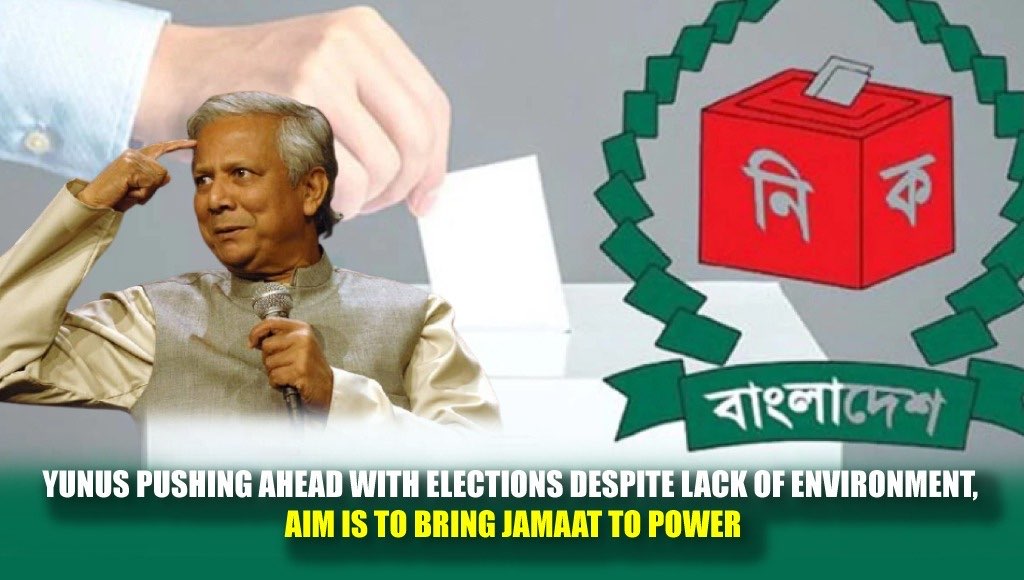

The interim government has set the election date for next February, even though there is no conducive environment for holding elections in the country. Security arrangements remain fragile. Amid this situation, Yunus and his associates are maneuvering to use the election to bring a particular party to power. That party is Jamaat. Sources say Yunus is determined to ensure Jamaat’s victory at any cost. The party has reportedly even been given a green signal for vote rigging.
Sources further claim that recent administrative reshuffles across the country have been carried out with Jamaat’s electoral victory in mind. A notable example of Jamaat’s influence within the administration is the incident at Jagannath Hall of Dhaka University. There, the hall administration removed murals depicting convicted war criminals and Jamaat leaders Golam Azam, Matiur Rahman Nizami, and Kader Molla—who had been portrayed as razakars—painted on Dhaka University roads in observance of Martyred Intellectuals Day. Not only the university, but the entire administration, according to the sources, has been arranged by Yunus in such a way that Jamaat can easily win the election.
During the Awami League era, the anti-state Jamaat had long been banned. It is now preparing to return to active politics. Meanwhile, Sheikh Hasina’s party, the Bangladesh Awami League, has been excluded from the election. As the interim government has banned the party’s activities, it will not be able to participate in the polls. Political tensions have further escalated following the recent death sentence handed down to Hasina by the International Crimes Tribunal in a case involving crimes against humanity.
Sheikh Hasina’s son, Sajeeb Wazed Joy, has warned that if the ban on the Awami League is not lifted before the February election, there will be massive protests and that “conflict will be inevitable.” He claimed that millions of party activists and tens of millions of supporters are ready to take to the streets.
Analysts believe that the political vacuum created by the banning of the Awami League could intensify competition between the BNP and Jamaat. At the same time, internal divisions within the parties could further increase the risk of instability.
Against this heated backdrop, a public shooting incident targeting Sharif Osman Hadi—potential independent candidate for the Dhaka-8 constituency and spokesperson of the Inqilab Manch—sparked nationwide outrage. The day after the election schedule was announced, assailants arriving on motorcycles shot him and fled. Hadi, who was shot in the head, is currently receiving treatment at Evercare Hospital.
Election monitoring organization Election Observer Society (EOS) has described the incident as a major threat to the democratic process. Under these circumstances, the likelihood of a fair election appears low. Nevertheless, the Election Commission remains adamant about holding the vote. Analysts say this clearly indicates that Yunus and his associates are determined to bring a particular party to power—and that party is Jamaat.