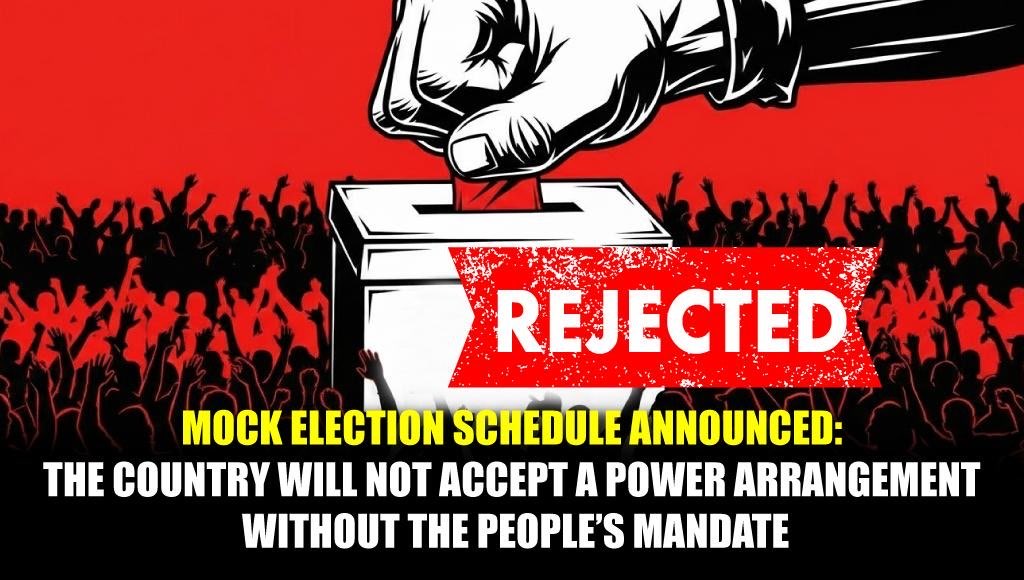

An election can be organized by announcing a schedule, but that does not establish democracy. Today’s reality in Bangladesh proves exactly that. The schedule announced by the illegal Yunus government does not carry the message of an electoral celebration; rather, it is a blatant declaration aimed at cementing a power arrangement by bypassing the people’s verdict.
This so-called election is not an election at all—it is a political farce. There is no competition, no meaningful participation, and no opportunity for the people to freely express their will. The allegation is clear: pro–Liberation War forces such as the Awami League, JASOD, and left-leaning parties have been deliberately pushed out of the electoral process. This is not merely political discrimination; it is a direct stand against the Constitution, the spirit of the Liberation War, and the democratic tradition.
The legitimacy of the Yunus government has been questionable from the very beginning. A government not elected by the direct vote of the people is now using the state apparatus to decide who will participate in the election and who will not. Where is the moral basis for such decisions? From where does this constitutional authority come? In reality, there are no answers—only administrative power and repressive tactics.
With the announcement of the schedule, it is being claimed that this is a procedural and lawful process. But the reality is that an election in which political forces representing nearly 70 percent of the population cannot participate can never be an election of the people. It is a vote without voters, a terrifying example of a people-less democracy.
In this situation, political parties and social forces aligned with the spirit of the Liberation War have made a clear call to the public—not to take part in this farce and not to go to the polling centers. This is not a call for chaos; it is a political protest, a moral stance. Because participating in an unjust process means legitimizing that injustice.
The controversial actions of the Yunus government are not limited to electoral restrictions alone. Suppression of dissent, obstruction of rallies and meetings, harassment of political activists, and the partisan role of the administration together make one thing clear: this government is not conducting an election—it is controlling one.
Democracy does not simply mean placing ballot boxes. Democracy means public trust, diversity of opinion, and equal opportunity. Where none of these exist, announcing an election schedule is nothing more than a tactic to cling to power.
History has repeatedly shown that one-sided elections never bring stability. Instead, they give rise to political deadlock, economic uncertainty, and a crisis of credibility on the international stage. The path on which the country is being pushed today carries a frightening message for the future.
The people of this country will not accept any power arrangement without their mandate. Announcing a schedule does not make an election, and without an election there can be no democracy. Boycotting the vote in protest of this farce is no longer merely an option—it has become the language of democratic resistance.