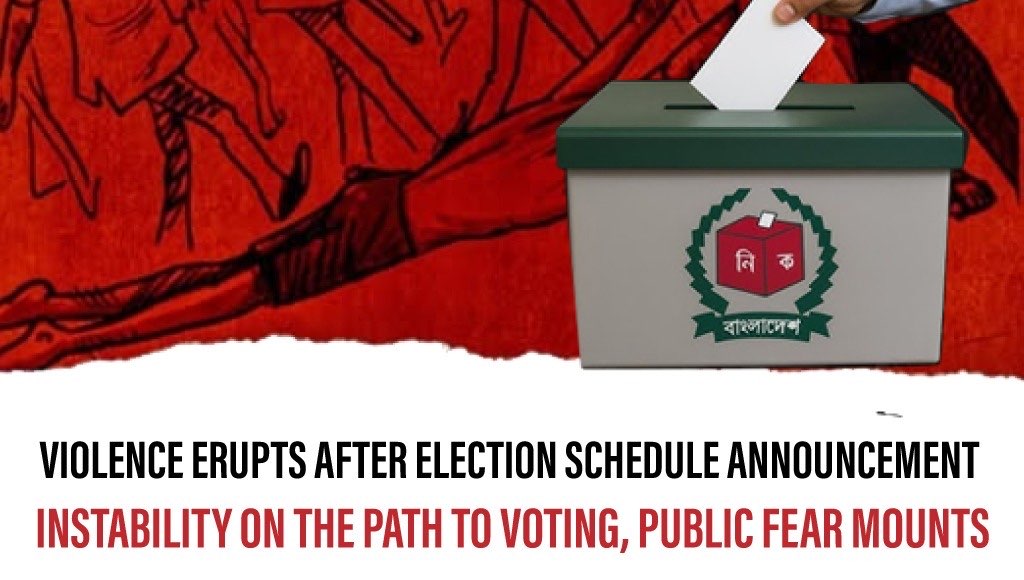

Following the announcement of the schedule for Bangladesh’s upcoming 13th National Parliamentary Election, a series of violent incidents has raised deep concerns about the voting environment and citizen safety. Even before 24 hours had passed since the Election Commission’s announcement, a prospective candidate was shot and hospitalized in critical condition. On the same night, arson attacks were carried out at upazila (sub-district) election offices in two districts. In the capital Dhaka, a moving bus was set on fire in a separate incident, and cocktails were hurled near a government office in Agargaon. The succession of these incidents clearly signals growing instability surrounding the election.
According to political and security analysts, the immediate outbreak of violence following the schedule announcement leaves little room to view these acts as the work of isolated criminal gangs. Rather, many believe this reflects a deliberate attempt to create fear and uncertainty around the electoral process. In particular, since the political shift in August last year, the deterioration in law and order across the country has heightened public insecurity and raised doubts about the state’s capacity to maintain control.
Despite nearly a year and a half of the interim government’s tenure, allegations persist that illegal weapons recovery, organized violence, and incidents of so-called “mob justice” have not been fully brought under control. In this context, while the Election Commission’s schedule announcement represents progress in the constitutional process, realities on the ground have made the voting environment even more complex.
A section of diplomatic and security analysts cautiously note that although discussions have long existed about illegal weapons being in the hands of various groups linked to political forces close to the current government—including the BNP, Jamaat, NCP, and others—no visible or coordinated initiative to recover these weapons has yet been observed. They argue that potential stockpiles of illegal arms could significantly increase the risk of election-time violence and pose a major obstacle to holding a peaceful vote.
Analysts further warn that illegal weapons pose not only direct security threats but can also serve as effective tools for pushing political competition toward violence. This could spread fear among voters, reduce turnout at polling centers, and increase the likelihood of post-election disputes—outcomes that are detrimental to the democratic process.
Amid the emerging situation, the Ministry of Home Affairs convened an emergency meeting on law and order. At a press conference afterward, Home Affairs Adviser Jahangir Alam Chowdhury declared that any attempt to obstruct or sabotage the national parliamentary election would be “suppressed with a firm hand.” He also stated that law enforcement agencies have been placed on the highest level of alert to ensure election-time security.
However, observers argue that beyond declarations of firmness, the true test will lie in neutral and visible implementation. Effective and transparent initiatives to recover illegal weapons regardless of political identity, swift investigation and accountability for violent incidents, and maintaining the professionalism of law enforcement agencies are all prerequisites for a credible election.
The upcoming election is not merely a constitutional exercise for Bangladesh; it is a critical test of the state’s law enforcement capacity, political tolerance, and democratic maturity. If a peaceful and acceptable election can be held by overcoming violence and fear, it will help rebuild public trust. Otherwise, the ongoing instability may lay the groundwork for deeper uncertainty in the future—affecting both domestic politics and the country’s international image.