
Bangladesh’s February 2026 Election: Why Legitimacy, Inclusion, and Security Are in Question
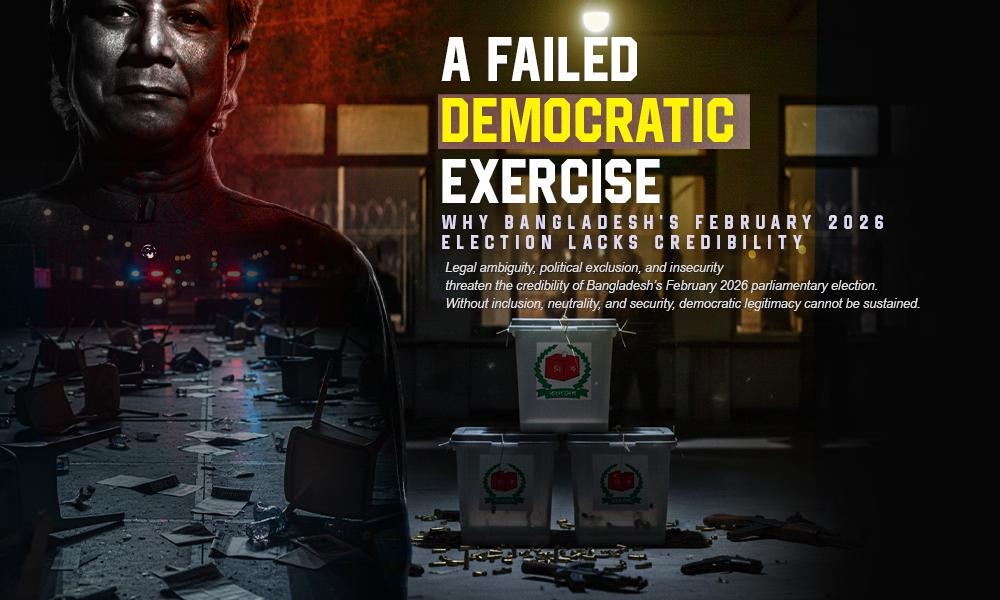
Bangladesh’s February 2026 parliamentary election is unfolding under conditions that raise serious concerns about its democratic legitimacy. Rather than reflecting an inclusive and competitive process grounded in constitutional order, the election appears procedurally fragile and politically constrained. Key concerns include the absence of a clear legal framework, the exclusion of major political parties and large segments of the electorate, escalating political violence, and questions regarding the neutrality of state institutions.
The election is being administered through executive decisions without a clear constitutional mandate or parliamentary validation, creating a legal vacuum at the core of the process. At the same time, the effective exclusion of key political actors has resulted in the disenfranchisement of an estimated 60 percent of voters, fundamentally undermining the election’s representative character. These structural deficiencies are compounded by a deteriorating security environment marked by targeted political killings, candidate intimidation, and weak or selective law enforcement.
Allegations of institutional bias and uneven enforcement of electoral rules have further eroded public confidence. Under these circumstances, international engagement carries significant risk. Election observation without substantive corrective measures may inadvertently legitimize a process that fails to meet basic democratic standards. For international observers, policymakers, diplomats, and media, the February 2026 election presents urgent concerns regarding democratic credibility and the broader implications of international recognition of a deeply flawed electoral exercise.
A Contested Transition and the Question of Interim Neutrality
Bangladesh’s February 2026 election is taking place amid an unsettled political transition following the collapse of the previous government in August 2024. An interim administration led by Nobel Peace Prize laureate Dr. Muhammad Yunus assumed power with a stated mandate to stabilize the country, restore institutional integrity, and oversee a neutral transition back to elected governance.
Over time, however, concerns have emerged regarding the expansion of executive discretion and the erosion of the interim government’s caretaker character. Key institutional reforms, particularly those related to electoral administration, political inclusion, and law enforcement neutrality, have remained incomplete, despite critical electoral decisions being made under the authority of the interim leadership.
Within this context, the Election Commission announced that parliamentary elections would be held on 12 February 2026, following direction from the interim government. The decision was taken without broad political consensus and amid unresolved disputes over participation and neutrality. Critics argue that setting an election date prior to securing inclusive and credible conditions has inverted the logic of democratic transition.
As a result, the pre-election period has been dominated by debate over disenfranchisement, legitimacy, and political exclusion, rather than electoral competition or public policy. Instead of serving as a neutral bridge to democratic restoration, the interim government has increasingly become a decisive political actor, shaping the electoral environment in ways that continue to raise doubts about the credibility and acceptance of the forthcoming polls.
Systemic Failures Undermining Electoral Credibility
Multiple structural failures have converged to undermine the credibility of the February 2026 election. The process is unfolding without a clear constitutional basis, amid political exclusion, administrative bias, and escalating violence. These conditions have weakened legal legitimacy, restricted genuine competition, and compromised the minimum requirements for a credible national election.
- Absence of a Legal and Constitutional Framework: The February 2026 election is being conducted without a clearly defined constitutional or statutory framework endorsed through parliament or judicial review. Key aspects of the electoral process, including timing, eligibility, and administrative authority, have been introduced through executive actions and political directives rather than established constitutional procedures. No universally accepted legal mandate governs the current framework, nor has a broad political consensus been secured. This absence of a consolidated constitutional pathway creates legal uncertainty and fundamentally undermines the legitimacy of the electoral process.
- Exclusion of Major Political Parties and Voters: The electoral process excludes major political actors, most notably the Awami League, Bangladesh’s oldest and historically largest political party, which has led the country for most of its post-independence period and maintains extensive nationwide organizational and voter support. International and regional reporting confirms that the party has been formally barred from participation.
Link: Awami League will not be allowed to participate in Bangladesh election
In addition, multiple registered political parties have withdrawn or have been unable to participate due to legal, administrative, or security constraints. Given long-standing party affiliations and electoral trends, analysts warn that without the participation of major parties, a substantial portion, potentially a majority of voters, may be left without meaningful representation, calling into question the national character of the election.
- Concerns Over the Neutrality of the Interim Government: The interim government, constitutionally expected to function as a neutral caretaker, faces widespread allegations of political bias. Multiple political actors and civil society voices have raised concerns regarding selective governance, uneven application of laws, and the use of administrative mechanisms in ways that appear to advantage certain groups while constraining others.
The concentration of executive authority and the absence of effective oversight have intensified perceptions that the interim administration is no longer operating at arm’s length from electoral outcomes, weakening confidence in the fairness of the process it oversees.
Link: Rising Fears of a One-Sided Election
- Fear of a One-Sided Election: The exclusion of major political parties, combined with a politically charged and constrained environment, has generated widespread concern that the election may be effectively one-sided, both in outcome and public perception. Without genuine competition among parties representing broad voter constituencies, the electoral process risks becoming a procedural exercise rather than a meaningful democratic contest.
- Escalating Political Violence: The pre-election period has seen a marked escalation in politically motivated violence, heightening concerns over the safety of democratic participation. The assassination attempt on student leader Sharif Osman Hadi, who was shot while campaigning in Dhaka and later died from his injuries, triggered widespread unrest and protests across multiple cities.
The incident underscored the volatility of the political environment in the run-up to the polls and the acute risks faced by active political figures.
- Alarming Scale of Violence and Casualties: Beyond high-profile cases like Hadi’s death, multiple violent incidents have occurred nationwide in the months preceding the election. A prominent Bangladesh Nationalist Party (BNP) leader, Azizur Rahman Musabbir, was fatally shot in Dhaka’s Karwan Bazar area, raising alarm over targeted attacks on party activists.
Separately, an opposition BNP leader, Alamgir Hossain, was killed in a drive-by shooting in Jashore, illustrating that violence extends beyond the capital to regional political contexts. While the body of a National Citizen Party (NCP) leader was found in Dhaka under unclear circumstances, investigations are ongoing.
Link: NCP leader found dead in Dhaka
Human rights and media reports also document ongoing clashes, shootings, and violent confrontations in multiple districts, including deadly episodes linked to rallies and local political mobilizations. The persistence of these incidents reflects a broader pattern of insecurity and politically related violence that affects both activists and ordinary citizens, conditions that are incompatible with the safety standards expected for credible electoral participation.
Link: Rising Violence and Deaths Raise Questions Over the Election Commission’s Role
- Pre-Campaign Violence and Candidate Intimidation: Reports indicate that threats, assaults, and coercion have occurred even before formal campaign periods began, affecting the ability of candidates and activists to organize freely. High-profile attacks on political figures, including the shooting of BNP candidate Ershad Ullah during campaign activity in Chattogram, where associated supporters were also injured, highlight the operational risks for candidates. Such incidents have reportedly led some prospective candidates to withdraw or reduce their public presence, contributing to a climate of intimidation that undermines open political competition.
Link: Security concerns before election
- Parliamentary Office as a Tool of Influence: The restricted and insecure political environment has increasingly turned parliamentary candidacy into a vehicle for personal advantage rather than democratic representation. With major parties excluded and institutional safeguards weakened, a growing number of aspirants, regardless of political legitimacy, eligibility, or public support, are seeking parliamentary seats as a means of securing influence, protection, or proximity to state power. As the parliamentary office comes to be viewed as a source of leverage and immunity rather than a public trust, the electoral process itself is distorted, contributing directly to the erosion of credibility surrounding the February 2026 election.
- Arbitrary Rejection of Candidates’ Nominations: The nomination scrutiny process has raised serious concerns, with a significant number of candidates disqualified on technical and inconsistently applied grounds. Election Commission data show that more than one-quarter of nominations were rejected nationwide, often for minor documentation or affidavit issues, while media reports indicate similar errors were treated differently across districts.
Although appeal mechanisms exist, the scale and opacity of the rejections have narrowed electoral choice and reinforced perceptions of administrative interference, further undermining confidence in the process.
Link: 89% journalists fear physical attacks during 2026 election coverage
- Weak and Selective Law Enforcement: Despite official directives to enhance security, violence and intimidation have continued with limited consequences. Investigations into politically sensitive incidents, including high-profile shootings, have been slow or inconclusive, and few cases have resulted in transparent accountability. This pattern has deepened perceptions of selective law enforcement, weakening trust in the state’s capacity to enforce security impartially during the election period.
Link: Questions Raised Over Restoring Law and Order Through Joint Force Operations
Taken together, these legal, political, and security failures form a mutually reinforcing cycle that prevents the election from meeting basic standards of competitiveness, inclusivity, and safety.
- Damage to Electoral Credibility Through Candidates’ Conduct: Public confidence in the electoral process has been further eroded by inflammatory and divisive rhetoric from certain candidates. Rather than elevating substantive policy debate, public discourse in some areas has centered on provocation and antagonism, intensifying polarization and diminishing trust in the electoral exercise as a constructive democratic forum.
- Violations of the Election Code of Conduct: Numerous violations of the election code of conduct, such as premature campaigning, misuse of administrative or public resources, and public disruptions, have been reported. Enforcement of these rules has been inconsistent, with limited visible consequences for offenders. This uneven application of electoral norms has amplified concerns about fairness and the institutional capacity to uphold rule-based electoral governance.
International Responsibility to Defend Democratic Choice in Bangladesh
The international community must not send election observers to Bangladesh under the present conditions. Doing so would legitimize an electoral process that excludes millions of voters, silences major political forces, and operates amid violence and fear. Observation in this context would not defend democracy; it would validate its erosion.
Bangladesh is bound by international law, including the International Covenant on Civil and Political Rights, to hold elections that genuinely reflect the will of the people. An election conducted without constitutional legitimacy, political inclusion, or safety cannot meet this standard. No technical monitoring can compensate for the absence of these fundamentals.
International silence, or premature endorsement, would abandon the Bangladeshi people at a critical moment. What is urgently required is decisive action: halting the current process, restoring a lawful and inclusive electoral framework, and ensuring a truly neutral interim authority. The people of Bangladesh are demanding democracy, not symbolism. The international community has a responsibility to stand with them, not to legitimize a process that denies their voice.
An election held under these conditions cannot restore democratic legitimacy and risks deepening Bangladesh’s political crisis rather than resolving it.