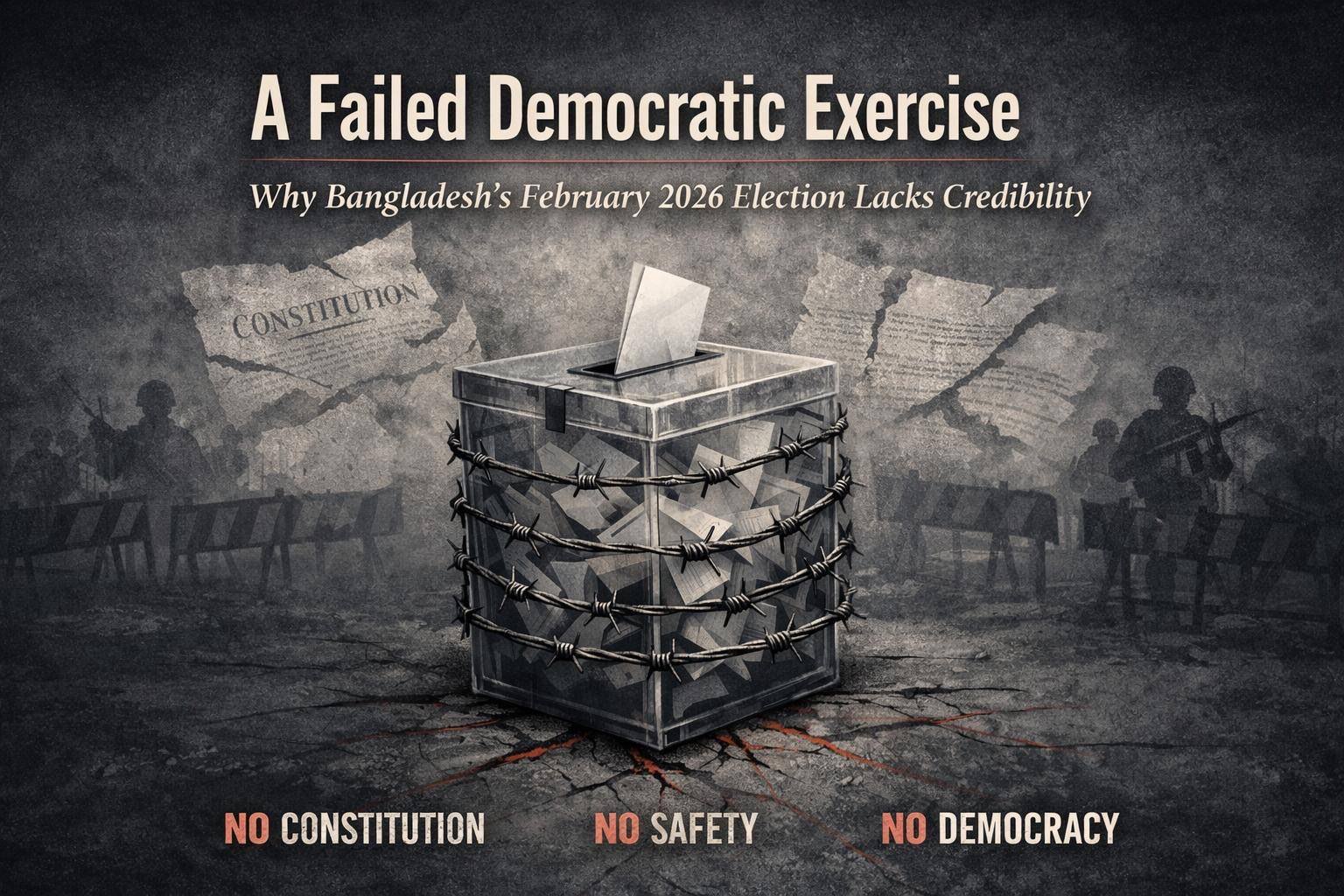

Bangladeshʼs February 2026 parliamentary election is unfolding under conditions that raise
serious concerns about its democratic legitimacy. Rather than reflecting an inclusive and
competitive process grounded in constitutional order, the election appears procedurally
fragile and politically constrained. Key concerns include the absence of a clear legal
framework, the exclusion of major political parties and large segments of the electorate,
escalating political violence, and questions regarding the neutrality of state institutions.
The election is being administered through executive decisions without a clear
constitutional mandate or parliamentary validation, creating a legal vacuum at the core of
the process. At the same time, the effective exclusion of key political actors has resulted in
the disenfranchisement of an estimated 60 percent of voters, fundamentally undermining
the electionʼs representative character. These structural deficiencies are compounded by a
deteriorating security environment marked by targeted political killings, candidate
intimidation, and weak or selective law enforcement.
Allegations of institutional bias and uneven enforcement of electoral rules have further
eroded public confidence. Under these circumstances, international engagement carries
significant risk. Election observation without substantive corrective measures may
inadvertently legitimize a process that fails to meet basic democratic standards. For
international observers, policymakers, diplomats, and media, the February 2026 election
presents urgent concerns regarding democratic credibility and the broader implications of
international recognition of a deeply flawed electoral exercise.
Read the documents below for more details.