
Is Bangladeshi politics once again standing at a crossroads where the future will be shaped not by the people’s mandate, but by the strategic interests of global powers? A leaked audio recording reported by The Washington Post has brought that uncomfortable question back into sharp focus. In the recording, a US diplomat openly states that Washington would like to see Jamaat-e-Islami, once a banned Islamist party in Bangladesh, as a “friend.” The obvious questions follow: why, and at what cost? And who will ultimately pay that price?
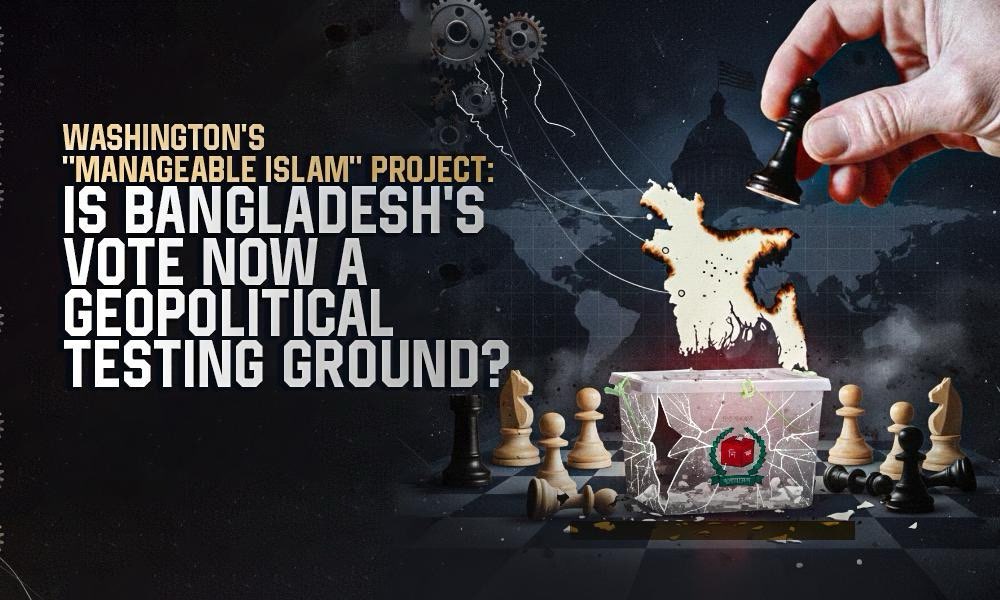
This was not an offhand diplomatic remark. It echoes a long-standing US policy often described as “manageable Islam” — Islamist forces that can win elections and command street influence, yet can be restrained when needed through economic pressure or the threat of sanctions.
After the fall of Sheikh Hasina, a political vacuum has emerged, and the United States appears to be searching for new power brokers. Democracy and human rights are not the primary considerations here. Stability and geopolitical calculation come first. Within that calculation, Jamaat-e-Islami has now found a seat at Washington’s table.
What is most alarming is who is absent from these diplomatic conversations. The people of Bangladesh are not there. Parliament is not there. There is not even an elected government. What remains is the colonial-sounding assertion: “We want them to be our friend.” Friendship in exchange for what? Principles? Sovereignty? Or an invisible veto over future political decisions?
The US diplomat claims that Jamaat would not be able to impose Sharia law, because the United States could, if necessary, impose 100 percent tariffs or shut down the garment industry. In other words, the livelihoods of four million Bangladeshi workers are being framed as political leverage. Is this friendship, or is it economic blackmail?
Another troubling signal emerges around India–Bangladesh relations. India has long viewed Jamaat-e-Islami as a regional security threat. Yet at a time when US–India relations themselves are strained, Washington appears ready to sideline Delhi’s concerns. As a result, Bangladesh risks becoming a testing ground for strategic divergence between the United States and India.
In this context, the position of the interim government cannot escape scrutiny. The government led by Dr. Yunus speaks of holding elections, but are the people being clearly informed about whom international powers are speaking to behind the scenes, and whom they consider acceptable political actors? Or will Bangladesh once again witness elections in form, while the real balance of power is decided in closed-door meetings at foreign embassies?
Jamaat is now presenting itself as a party of anti-corruption and good governance. But can history be erased so easily? The legacy of 1971, war crimes, women’s rights, and the treatment of minorities — can all of this be brushed aside under the banner of “image softening”? Or will these questions be dismissed as inconvenient in exchange for international acceptance?
The role of the BNP is also deeply ambiguous. On one hand, it signals reluctance to include Jamaat in any alliance. On the other, political arithmetic suggests that Jamaat’s entrenched strength cannot be easily ignored. This opens the door once again to politics driven by unprincipled compromise.
Taken together, the picture is clear. Bangladesh’s election is no longer just a contest for a change of government. It has become a focal point of strategic interest for the United States, India, and even China. In this game, the voices that matter least are those of ordinary voters, workers, minorities, and women.
The question, ultimately, is simple:
Is Bangladesh once again entering a system where people are allowed to vote, but the remote control of power remains abroad?
If this question is not confronted today, tomorrow there may be no opportunity left to answer it.