

Bangladesh’s new government is confronting a stark financial inheritance, as widening deficits, mounting debt repayments and costly campaign pledges collide with the country’s limited revenue base.
Official figures indicate that in the first half of the 2025–26 fiscal year the state collected roughly $18.3 billion in revenue but spent more than $20.5 billion, forcing authorities to borrow about $2.7 billion in just six months. The shortfall underscores a deeper structural problem: government spending continues to rise faster than its ability to generate income.
The annual budget, set at about $64.8 billion, already depended heavily on borrowing. Yet even before new policies take effect, the treasury faces significant obligations — from interest payments and subsidies to unpaid energy-sector bills. Analysts warn these liabilities leave little room for new spending without further debt.
When the Bangladesh Nationalist Party administration assumed office in February, it inherited public debt exceeding $18.9 billion. At the same time, it pledged major welfare programmes, including cash-support schemes for households and new assistance initiatives for farmers and religious workers.
Economists say these commitments raise a central question: whether political promises are being made faster than they can be funded.
Fiscal data suggest the government’s everyday costs are already dominated by obligations it cannot easily cut. Interest payments, subsidies, wages and institutional support absorb the bulk of routine expenditure, limiting flexibility to redirect funds. Without either significant tax increases or spending cuts elsewhere, financing new programmes could deepen reliance on borrowing.
Debt repayments alone are set to intensify the pressure. Projections from the International Monetary Fund indicate Bangladesh must repay around $30.6 billion in loans this fiscal year, rising to nearly $33.8 billion the next. These figures dwarf the government’s fiscal margin and could strain foreign currency reserves if export earnings or remittances weaken.
Meanwhile, unresolved liabilities in the power and energy sector — estimated at roughly $3.7 billion — continue to accumulate. Energy supply shortages remain a risk to industrial output and employment, meaning the government may have little choice but to maintain expensive fuel imports even while attempting to curb spending.
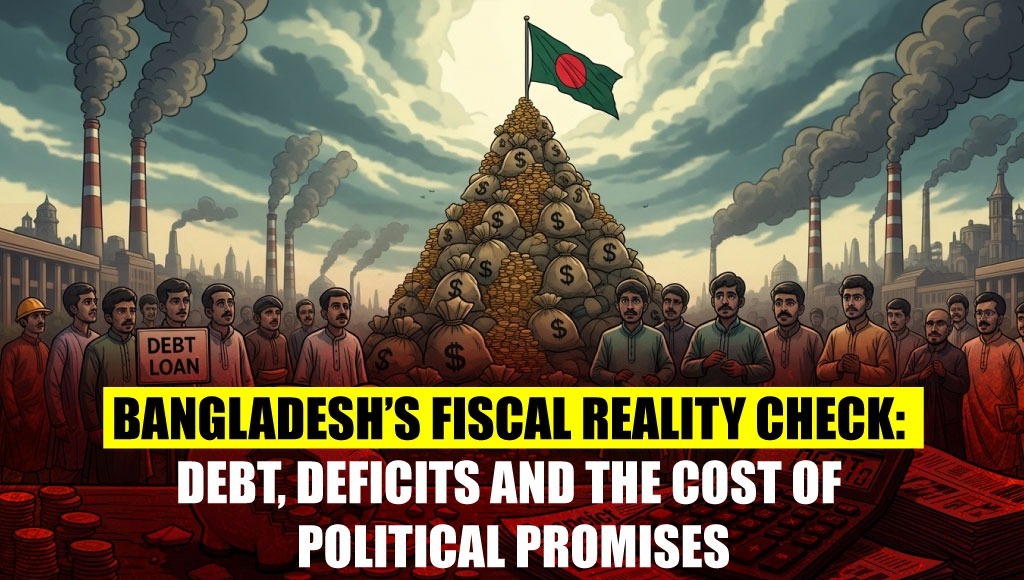
[Bangladesh’s Fiscal Reality Check: Debt, Deficits and the Cost of Political Promises]
Former World Bank economist Zahid Hossain notes that while some development projects could be trimmed, the core fiscal pressures are unavoidable. Clearing arrears, managing debt and addressing public-sector wage demands are likely to increase, not reduce, expenditure in the near term.
The underlying challenge is structural rather than temporary. Bangladesh’s tax-to-GDP ratio remains among the lowest in comparable economies, limiting the state’s ability to finance social programmes domestically. Raising taxes could boost revenue, but doing so risks political backlash and further inflationary pressure on households.
The result is a narrowing set of choices: borrow more, tax more, or scale back promises. Each carries economic and political costs.
As the government begins implementing its agenda, the sustainability of Bangladesh’s public finances — and the credibility of its policy commitments — may soon face their most serious test in years.