
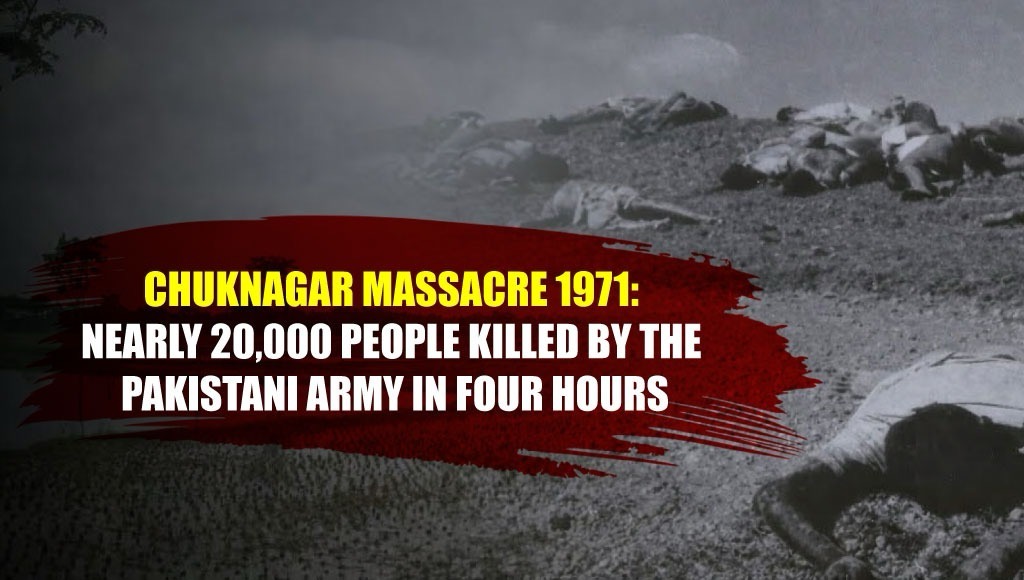

Chuknagar Massacre 1971: Nearly 20,000 People Killed by the Pakistani Army in Four Hours
In the history of Bangladesh’s Liberation War, the largest single-day massacre occurred on 20 May at Chuknagar. On that day, a single platoon of Pakistani soldiers carried out continuous brushfire for about four hours, killing at least 20,000 innocent people.
Chuknagar was a well-known route for people crossing the border through Satkhira into India. On 20 May, thousands of people from Khulna, Jessore, Pirojpur, Bagerhat, and several other districts had gathered in Chuknagar in hopes of reaching refugee camps in India. Earlier, from late April, the Pakistani army had carried out mass killings in many Hindu-majority areas of these regions. Those who survived those brutalities planned to flee to India through Chuknagar in search of safety.
As there was no space left in houses in the area, people spent the night wherever they could—markets, shops, and school verandas. Nearly 30,000 people had taken shelter in Chuknagar that day. The Pakistani army seized this opportunity.
From 12 noon to 4 pm on 20 May, a platoon of Pakistani soldiers fired relentlessly and without obstruction across an area of roughly one square kilometer. With the assistance of local collaborators (Razakars), they entered the villages and carried out the massacre.
[Chuknagar Massacre 1971: Nearly 20,000 People Killed by the Pakistani Army in Four Hours]
People were killed while standing on the riverbanks, hiding in ponds, swimming across the river to escape, or even while hiding in tree branches. The Pakistani soldiers killed people wherever they found them. Men, women, children, and the elderly—no one was spared.
A description of the Chuknagar massacre comes from Sardar Muhammad Nur Ali, a teacher from the nearby village of Rustampur. He said:
“It was a hellish scene—impossible to forget. The massacre stretched across nearly four miles in our area. Some bodies were thrown into the river, while others were buried to avoid the stench. For two months, people in the area did not eat fish from that river. Out of fear, people avoided the market for five to six months.”
After the Pakistani forces left, a six-month-old baby was found breastfeeding from her dead mother. That silent witness to the massacre—Rajkumari Sundari—is still alive today.