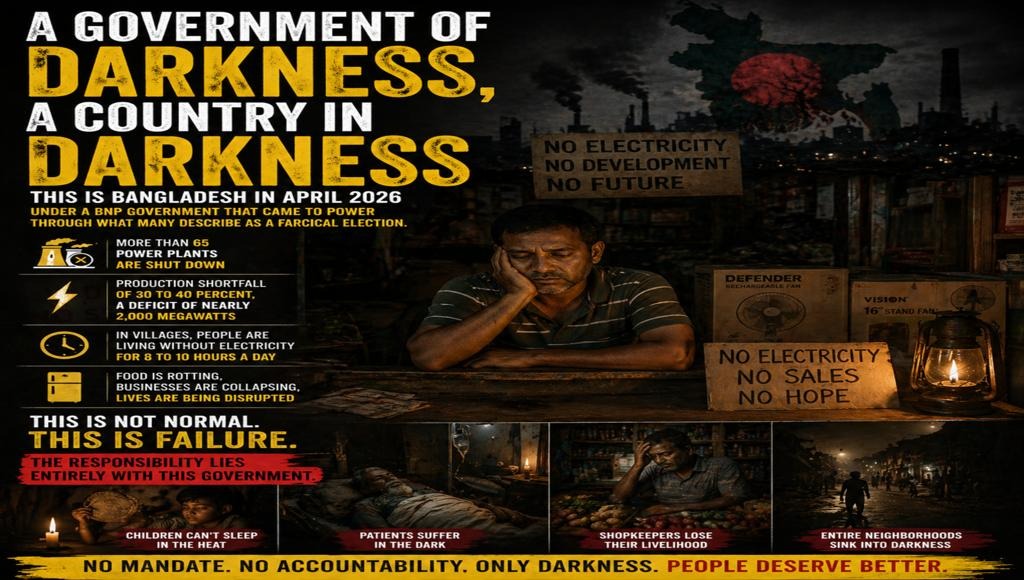

Imagine a small electronics shop in Satkhira. The shopkeeper has been sitting there since morning, but there are no customers. Fans aren’t selling — because what’s the point of buying a fan when there’s no electricity?
This situation isn’t the result of any natural disaster. It is entirely man-made — the outcome of political indecision and an irresponsible administration.
More than 65 power plants are shut down. There’s a production shortfall of 30 to 40 percent, creating a deficit of nearly 2,000 megawatts. In villages, people are living without electricity for 8 to 10 hours a day. Food stored in restaurant refrigerators is rotting. Clothing stores are sitting empty. This is Bangladesh in April 2026 — under a BNP government that came to power through what many describe as a farcical election.
People haven’t forgotten how this government came to power. In the February 12 election, major political parties did not participate. Ordinary citizens didn’t turn out to vote. An election without public participation or real competition is not truly an election — it’s a staged performance. And through that performance, this government now rules, leaving millions in darkness while speaking of development.
The BNP is a political party — but how was it formed? Founded by Ziaur Rahman during his time in military power, the party has, over decades, normalized a culture of corruption and muscle-based politics in Bangladesh like no other. It has come to power repeatedly and left repeatedly — but each time, it has left behind deeper layers of mismanagement and exploitation.
[A Government of Darkness, A Country in Darkness]
So what is the current cabinet doing about the electricity crisis? There are no urgent measures, no clear explanations, no timelines. When ministers speak, they often act as if power outages are normal — as if people should simply accept them. But this is not normal.
In the intense heat of April, when a child cannot sleep at night, when a patient lies in a hospital without electricity, when a shopkeeper spends the whole day without making a single sale — this is failure. And the responsibility for that failure lies entirely with this government.
Perhaps it is unrealistic to expect accountability from a government whose legitimacy itself is questioned. But people’s lives haven’t stopped. Businesses are collapsing, food is spoiling, entire neighborhoods sink into darkness after sunset.
And in the face of this darkness, the ministers have no answers — because to answer, you must be accountable to the people. And that accountability begins with a public mandate they simply do not have.