
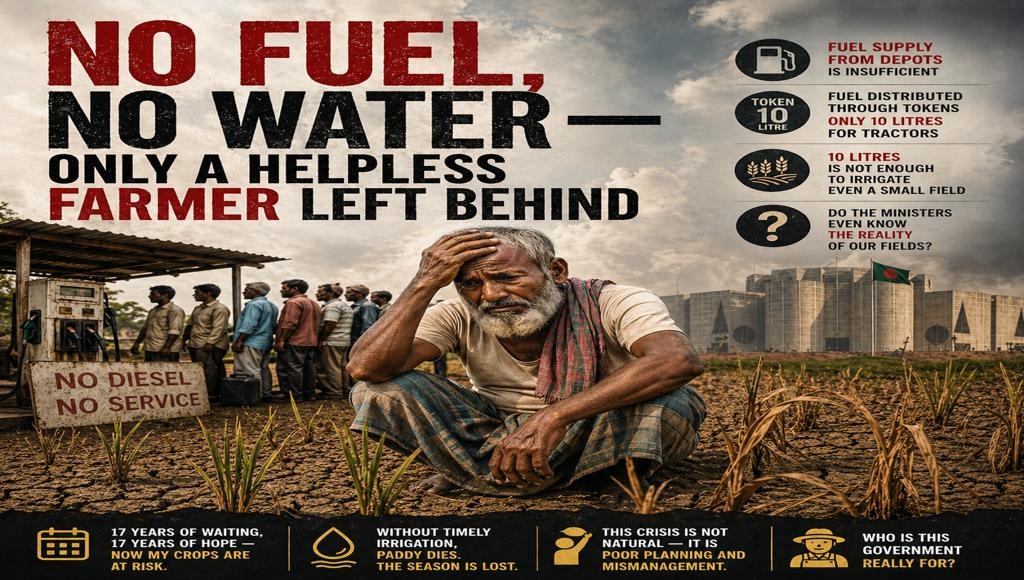

Tara Sheikh, a farmer from Saltha upazila in Faridpur, planted paddy this year after 17 years. Seventeen years of hope, seventeen years of waiting. And now, he cannot irrigate his land because there is no diesel. For days, he has been going from one pump to another, returning empty-handed. One day he managed to get a small amount, but it wasn’t enough for irrigation. Now he is counting the days until his crops fail.
Has the BNP government thought even once about people like him? The election held on February 12 was more of a staged event than a real vote — major political parties were absent, ordinary people didn’t participate, and the whole thing felt like a pre-arranged game. Through that process, BNP came to power, and now their so-called ministers are running the country. What does “running a country” mean? Tara Sheikh could explain it better — it means ensuring fuel supply when farmers need it most, like in April when paddy fields require irrigation. This government has failed to do that.
The general secretary of the district petrol pump owners’ association himself admits that fuel supply from depots is insufficient. Pumps cannot meet demand. Fuel is being distributed through tokens, and tractor drivers are getting only about 10 liters each. Do the ministers even know how much land can be irrigated with 10 liters? Probably not. Leaders who grew up in the comfort of cantonments hardly understand the realities of the fields.
There is nothing new in BNP’s history. Its links with corruption and violence have been evident for decades. This time, however, it has come to power through a questionable election with little public participation. Expecting accountability from a government lacking legitimacy may be unrealistic. Still, people continue to hope — because that’s human nature.
[No fuel, no water — only a helpless farmer left behind]
Farmers like Tara Sheikh may or may not understand politics, but they understand this: without timely irrigation, paddy dies. If jute seedlings dry up, the entire season is lost. When a government cannot grasp or act on such basic realities, its cabinet is a cabinet only in name. To the farmers of Faridpur, these ministers hold no real value — nor should they.
This fuel crisis did not appear overnight. It is the result of poor planning and mismanagement — something long associated with BNP. A party that has repeatedly bypassed democratic norms and relied on questionable elections may not be expected to deliver good governance. But when people are left helpless, when an elderly farmer says, “I don’t know if I can save my crops,” the question naturally arises: who is this government really for?