
The index released this year by Reporters Without Borders ranks Bangladesh 152nd out of 180 countries—three places lower than last year. This time, the country’s media environment has been labeled as “very serious.” Pause and think about that number: 152. It means only 28 countries in the world have a worse situation for journalism than Bangladesh. Yet this government and a section of media aligned with it are trying to present this as a “success.”
This is BNP’s so-called “New Bangladesh.”
The discussion around the February 12 election cannot be avoided. Excluding major political parties, amid a widespread boycott by ordinary citizens, those who came to power through what many describe as a staged contest are now posing as guardians of the country’s media. A party born in a military cantonment, whose founder seized power bypassing democratic processes, is now delivering grand lectures on press freedom. It doesn’t take much intelligence to spot the contradiction.
RSF notes that Bangladesh’s score in the political context indicator has dropped significantly. In other words, journalism lacks political backing for autonomy, faces state pressure, and dissent is not tolerated. This is nothing new. Historically, BNP’s relationship with the media has never been comfortable. Those who question and demand accountability have rarely found a supportive environment. This time is no different.
Looking at the media itself makes things even more frustrating. Under BNP rule, the volume of rumors, misinformation, and biased reporting has been so high that the 152nd position is hardly surprising. A large segment of the media is no longer reporting news—it is broadcasting partisan propaganda. When the line between truth and falsehood disappears, should the press freedom index rise or fall?
Nepal is 65 places ahead of Bangladesh. Bhutan is ahead by 2 places. Sri Lanka by 18. Countries once looked down upon have now surpassed Bangladesh in media freedom. Meanwhile, Bangladesh sits just 5 places above Pakistan—a country long criticized for its political structure, military interference, and troubled media landscape. Calling this “progress” raises serious questions about judgment.
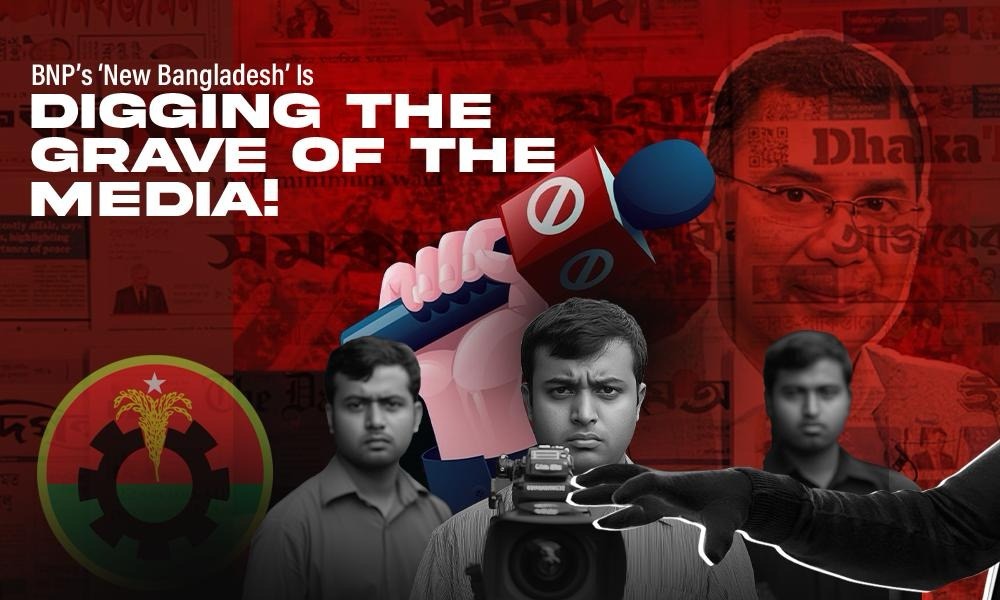
[BNP’s ‘New Bangladesh’ Is Digging the Grave of the Media!]
RSF also reports that for the first time in 25 years, the global average score has dropped to its lowest level. More than half of the world’s countries are now classified as “difficult” or “very serious.” In 2002, about 20% of the global population lived in countries with good media conditions; now that figure has dropped to just 1%. Even within this global decline, Bangladesh continues to fall behind—suggesting that the problem is internal and self-created.
A government that seeks to turn the media into its mouthpiece, that views journalists’ pens and cameras with suspicion, cannot be expected to improve press freedom. And it hasn’t. Trying to pass off the 152nd position as an achievement is just as absurd as calling a staged election democratic.