
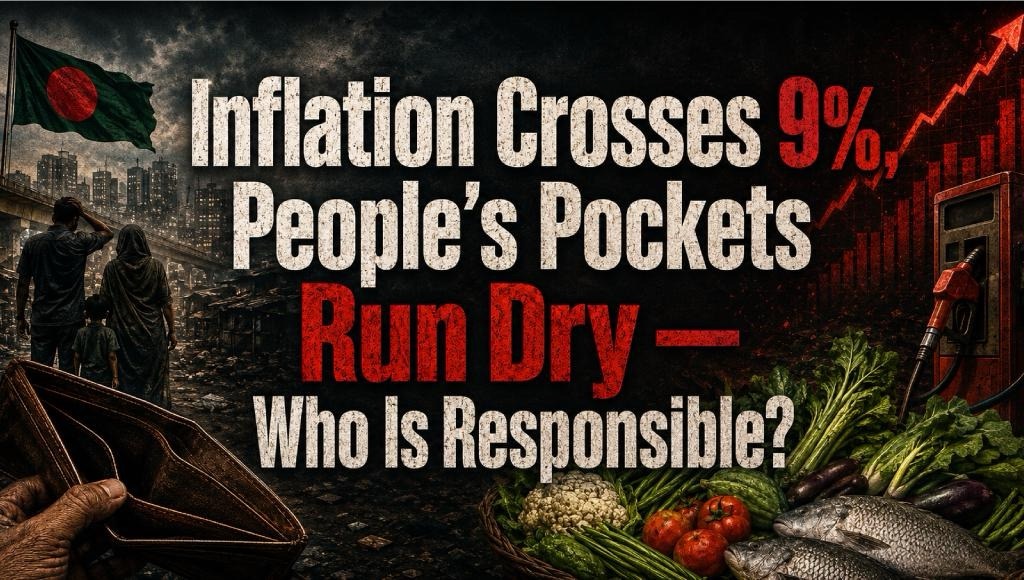

In April, inflation reached 9.04 percent. The Bangladesh Bureau of Statistics provided the number, but the suffering behind that figure cannot be captured in statistics. In five of the last six months, inflation has remained above 9 percent. It dipped slightly in March, giving some people hope—but that hope disappeared again in April.
Those who are called the “middle class” in this country have long since slipped into the lower-middle class. They are squeezed from both sides—unable to move up, yet unwilling to admit they have fallen. Like being stuck in a split bamboo trap, and now that trap is tightening further.
On April 19, the government increased fuel prices. Diesel rose from 100 to 115, kerosene from 112 to 130, octane from 120 to 140, and petrol from 116 to 135 taka. This increase hits transportation first, then the market, and finally the kitchen. Within just two weeks, vegetable prices have gone up by 10 to 15 taka per kilogram. Fish and meat prices are also rising. At these rates, it has become nearly impossible to balance household expenses.
Yet in April, the national average wage increased by only 8.16 percent. Inflation is above 9 percent, but wages are rising by less than 8 percent. This means people are falling behind month by month. Real income is shrinking. Debt is increasing—or people are forced to eat less, buy fewer clothes, and even skip medicine.
In this situation, the government in power must be discussed. The election held on February 12, 2026, did not include the country’s major political parties. People rejected that election. Yet the BNP has formed a government based on it. The party’s origins in military rule under Ziaur Rahman is a history it has never been able to hide. Its links to corruption and violence are not new.
But the biggest question now is about money. The Yunus government reportedly took loans of 24 lakh crore taka in 18 months. Meanwhile, the so-called elected BNP government claims it began with a foreign debt burden of 30 lakh crore taka. So where did the additional 6 lakh crore taka go in just two months? The people of the country have seen no benefit. There is no fuel, no electricity, no healthcare, and food prices are soaring. Will this illegal BNP government ever answer for this 6 lakh crore taka?
[Inflation Crosses 9%, People’s Pockets Run Dry — Who Is Responsible?]
People now understand deeply that even if inflation rates fall, prices do not necessarily come down. Once prices rise, they rarely drop easily. The dynamics of rising and falling are not the same. The government understands this truth—but refuses to acknowledge it.
There is concern that the situation may worsen further by the end of June. New pressures may emerge before and after the national budget. Once fuel prices rise, their impact continues to ripple through the market for months—and that effect has not yet been fully reflected.
What fault do ordinary people have? Their only “fault” is being born in this country. They work, pay taxes, accept rising prices, take loans, and struggle to sustain their families. Meanwhile, those who claim to make decisions on their behalf are in power without a public mandate—and cannot account for vast sums of money.