
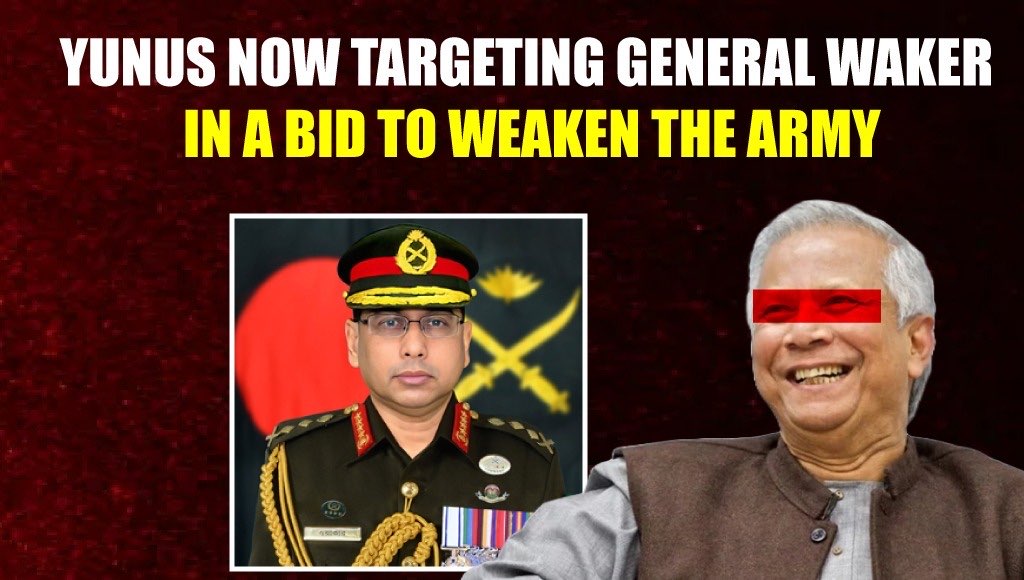

Dr Muhammad Yunus and the groups loyal to him are now aggressively trying to weaken the Bangladesh Army. The latest example is the report by the so-called National Independent Investigation Commission formed by the current interim government to probe the brutal BDR massacre at Pilkhana. The report shows how the government’s meticulous design twisted the entire incident and shifted the blame onto the Awami League. Those involved say the real target of this report is Army Chief General Waker-Uz-Zaman. The government, especially Yunus, wants to stay in power until Western objectives are fulfilled. Weakening the army is central to that plan.
The commission formed by Yunus claims that the main coordinator of the incident was then-MP Sheikh Fazle Noor Taposh, and that the entire operation took place with the “green signal” of then Prime Minister Sheikh Hasina. The report also suggests India’s involvement.
Sources say General Waker was sent to Pilkhana during the 2009 BDR mutiny as well, but he was not given clearance to launch an operation due to fears of heavy casualties. Yet the new report accuses him too. The investigation committee formed by the army at the time was led by Lt Gen (retd) Jahangir Alam Chowdhury, now the Home Affairs Adviser. His report contained no such allegations. Sixteen years later, Yunus has introduced new claims.
After the recent report on Pilkhana, Rakin Ahmed Bhuiyan, the son of former BDR (now BGB) Director General Maj Gen Shakil Ahmed, spoke publicly. At a press conference, he claimed Sheikh Hasina carried out the Pilkhana killings to serve India’s interests. Sources say Rakin is a drug addict, and that Yunus used him as part of a larger, carefully crafted plan.
Yunus and his followers have repeatedly tried to undermine the army. Analysts say their strategy is to strengthen militancy and allow Western interests to extract Bangladesh’s resources.
A speech by Bangladesh/AB Party General Secretary Asaduzzaman Fuad went viral some time ago, where he threatened to “blow up the cantonment.” Later, Inquilab Manch’s Osman Hadi threatened to “pull out the bricks of the cantonment.”
Hasnat Abdullah, chief organiser of NCP’s southern region, said to the army: “Let me be clear. Those of you whose duty is in the cantonment should stay in the cantonment.”
NCP’s chief coordinator Nasiruddin Patwari warned that they would “tear down” the headquarters of DGFI, Bangladesh’s top intelligence agency.
Sources say weakening the army would make it easier to firmly establish militancy in the country. The two masterminds behind this blueprint, they say, are Pakistan and the United States.
Pakistan wants revenge for its defeat in the Liberation War. That is why the country is trying in every possible way to promote militancy in Bangladesh. Just last month, the Anti Terrorism Unit arrested a man named Shamin Mahfuz for alleged links with the Pakistan-based banned militant group Tehrik-e-Taliban Pakistan (TTP).
A top leader of Pakistan-based militant group Jamaat-ud-Dawa recently claimed they played a role in Bangladesh’s instability and the fall of Sheikh Hasina’s government. The Home Affairs Adviser also noted that Bangladesh and Pakistan have agreed to work together on combating drugs and terrorism. Analysts ask how Pakistan can help Bangladesh fight terrorism when it struggles to control terrorism at home. They say there is a deeper conspiracy behind this.
Meanwhile, the United States—Bangladesh’s old adversary—also has clear strategic calculations. Like in many countries, Washington has pushed events similar to the Arab Spring. If militancy becomes well-established in Bangladesh, it will give the US a pathway to control natural resources and key strategic areas.
A core element of the US long-term strategy is expanding its influence in Southeast Asia. After China-aligned deep seaport projects in Myanmar, the US has stepped up its strategic moves in the region. The Rohingya crisis, humanitarian corridors, and the significance of Chittagong Port have all made this region a key battleground for China-US rivalry. The army has consistently opposed these external pressures.
Multiple sources and analysts believe Nobel laureate Muhammad Yunus is being used by the US administration as a “proxy leader” for this agenda. They claim he is being promised the post of UN Secretary-General in exchange for serving Western interests. As part of this plan, they point to support for Myanmar rebels, attempts to obstruct China’s Belt and Road projects, and the creation of instability in Bangladesh.
Analysts warn that without a credible, free, and fair election, the country’s sovereignty and internal stability could face serious risks. They say the public must remain alert so Bangladesh does not become a tool for any foreign power in this geopolitical contest.