
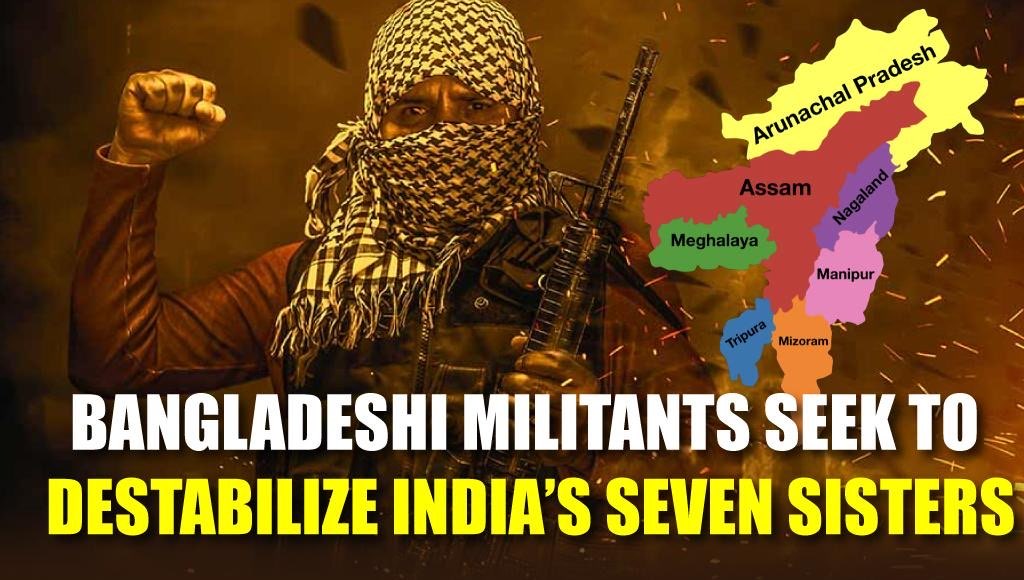

In the security landscape of South Asia, India’s northeastern region—known as the “Seven Sisters”—has long been geopolitically sensitive. Recently, some security analysts and regional observers have expressed concern that several Bangladesh-based extremist and militant networks are stepping up renewed activities targeting this region. Public statements, symbolic pledges, online propaganda, and organized rhetoric using language hostile to India’s sovereignty are intensifying these concerns.
According to security sources and analysts, the groups whose names repeatedly surface in connection with such activities include Jama’atul Mujahideen Bangladesh (JMB), Harkat-ul-Jihad al-Islami (HuJI), Ansar al-Islam, Hizb ut-Tahrir, and networks ideologically influenced by the internationally banned Islamic State (IS). In addition, observers are raising questions about similarities between the rhetoric used in some statements and movements of Hefazat-e-Islam—known as a hardline social platform—and the narratives of these extremist groups.
A clear common thread runs through the rhetoric of these groups: a tendency to portray India’s northeastern region as “strategically weak” or “separable.” Analysts argue that such language is not merely ideological posturing; rather, it is a well-known tactic aimed at fomenting regional instability. South Asian history shows that instability in the Seven Sisters region has repercussions for the security of neighboring countries as well.
A major source of concern is the growing confidence of these militant networks. Observers note that extremists tend to become reckless when they perceive the state as indecisive or normatively weak. In recent times, allegations of administrative instability, policy ambiguity, and inadequate effective surveillance in Bangladesh have created an environment that extremist forces are exploiting. Open threats, incendiary speeches at gatherings, and the fearless use of violent language on social media reflect this reality.
An even more serious allegation involves the silent inaction of certain elements within the state. Some security analysts argue that the absence of visible and sustained resistance to extremist activities effectively amounts to indirect patronage. In particular, allegations of lax attitudes or political pressure within certain levels of law enforcement are calling into question the state’s professed tough stance.
In this context, concerns about foreign linkages cannot be dismissed. Past connections between HuJI and JMB with Pakistan-based extremist networks, IS-aligned propaganda tied to international jihadist ideology, and allegations of financial and logistical support from sources in the Middle East and South Asia together indicate that the issue is no longer confined to internal security alone. It has become a matter of regional and international security concern.
From India’s perspective as well, the issue is clearly sensitive. If provocative rhetoric or organized activities targeting the Seven Sisters are conducted from the territory of a neighboring state, it places serious strain on bilateral relations. Bangladesh, which has long presented itself as a responsible neighboring country, risks damage to its international credibility if faced with such allegations.
Analysts believe that in this situation, denial or silence alone is insufficient. Transparent and independent investigations into the names, networks, and financial–logistical sources of militant groups; the non-selective, universal application of anti-extremism laws; and open diplomatic engagement with neighboring states are all urgently needed.
History has repeatedly shown that neglecting extremism or tolerating it for political calculations never results in limited consequences. If the rhetoric and activities now seen around the Seven Sisters are not confronted firmly and immediately, their impact will not remain confined to Bangladesh or India alone—it will call into question the overall stability of South Asia.
In this reality, the message is clear: suppressing extremism is not a matter of diplomatic courtesy; it is a responsibility of the state. Silence here is not neutrality—silence itself is a risk.