
A Threat That Exposes the Truth
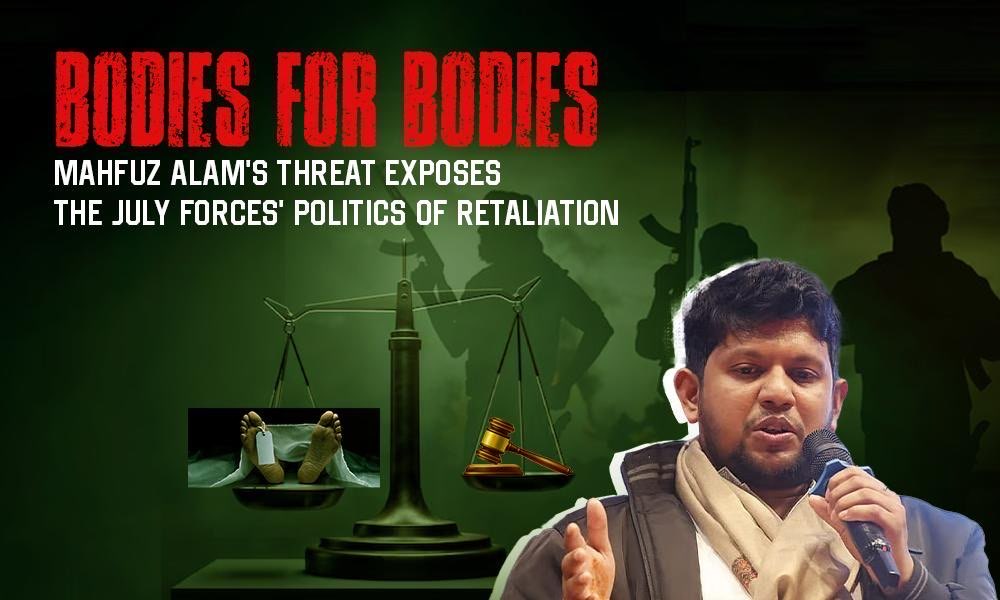
Mahfuz Alam’s statement –“If one body falls, we will take bodies too”– is not a moment of rage or a rhetorical slip. It is a doctrine. It articulates a political mindset where violence is not a tragedy to be prevented, but a tool to be answered, replicated, and normalized.
Mahfuz Alam Threatens Retaliatory Killings in Public Statement
What makes this statement especially damning is not just its content, but its source. Mahfuz Alam was part of the interim government until only days ago, an arrangement publicly marketed as neutral, reformist, and above partisan bloodletting. Yet here is a former state-linked figure openly endorsing retaliatory killing, speaking the language of vengeance rather than law, justice, or restraint.
This single statement collapses the carefully constructed narrative around the July forces and the interim setup. A government that claims moral superiority cannot coexist with threats of “bodies for bodies.” A movement that presents itself as democratic cannot justify power through the promise of counter-violence. Mahfuz Alam did not merely make a threat; he exposed the truth behind the rhetoric: this was never about reform, but about retaliation dressed up as revolution.
NCP preparing for Turkish-style armed jihad in Bangladesh
Power Through Blood, Blame, and a Broken State
The July uprising was sold to the public and the international community as a democratic revolt, a spontaneous eruption against authoritarianism. In practice, it unfolded through deliberate chaos, street violence, mounting deaths, and an atmosphere of fear that was neither accidental nor unforeseen. This was not a peaceful movement that turned violent; it was a movement that advanced through violence. The principle now openly articulated as “bodies for bodies” was not a post-facto reaction; it was the underlying mechanism of regime change.
Violence created momentum. Momentum created paralysis. Paralysis delivered power.
Who were the youths carrying 7.62mm rifles meant for police, Rab?
This approach followed a well-established and cynical strategy. For years, the same political camp perfected the art of violent escalation followed by moral deflection. Deaths were provoked, not prevented. Corpses were weaponized, not mourned. Each incident was swiftly repackaged as state repression, and responsibility was reflexively assigned to the Awami League, regardless of context, evidence, or culpability. The narrative was simple and effective: chaos on the streets, outrage in the media, and blame directed upward. What remained hidden was the uncomfortable truth that violence was not merely endured by this camp,it was politically useful to it.
AL is blamed for mass killings, but Yunus Gang admitted it already
Now, with power secured, the pretense has collapsed. The language of human rights has given way to the language of retaliation. The claim of moral superiority has been replaced by open threats of counter-violence. Mahfuz Alam’s statement is not an aberration; it is a confession. It confirms what critics long argued and supporters long denied: this movement never rejected the politics of blood; it mastered it, while outsourcing moral blame to its opponents.
It is at this point that the interim government’s credibility fully disintegrates. An interim setup is meant to be neutral, restrained, and governed by law. But an arrangement that tolerates, normalizes, or produces rhetoric of retaliatory killing is morally bankrupt by definition. When individuals who were part of the state apparatus until days ago publicly threaten bloodshed, the rule of law is not merely weakened; it is functionally dead. Authority no longer flows from institutions, legality, or consent, but from the implied threat of violence.
This is not transition governance. This is a mob-backed authority. It is a system where intimidation replaces legitimacy, retaliation replaces justice, and fear replaces accountability. The July forces did not dismantle a culture of violence; they rebranded it, redirected it, and now openly defend it. What was once denied is now declared, and Bangladesh is being pushed toward a political order where power is measured not by ballots or laws, but by the arithmetic of corpses.
Where Is Bangladesh Heading?
Bangladesh is sliding into lawlessness, fear, and the open politics of revenge, and this collapse has a name at the top. When influential figures openly threaten “bodies for bodies” and face no rebuke, no consequence, no restraint, violence stops being deviant and becomes sanctioned. Fear becomes policy. Intimidation becomes authority.
This descent did not happen in a vacuum. Professor Muhammad Yunus chose silence when retaliation was preached. He chose inaction when political violence was normalized. Mahfuz Alam was part of Yunus’s cabinet until days ago, not a fringe agitator beyond state reach. When a cabinet-linked figure threatens bloodshed and the head of government says nothing, the message is unmistakable: revenge has approval by omission.
This is not institutional weakness; it is institutional abdication. Police exist, courts exist, ministries exist, but they are subordinated to a political climate where counter-violence is tolerated, and accountability is optional. The rule of law is not merely eroded; it is displaced by silence from the very office meant to uphold it.
What follows is a state governed by the arithmetic of corpses. Each death licenses the next. Each threat deepens fear. Authority flows not from law or justice, but from the confidence that retaliation will go unpunished. This is not drift. It is direction, set by leadership that refuses to draw a line, and thereby invites blood to cross it.