

National Equipment Identity Register. Sounds good, right? Very high-tech, very modern. But what’s actually happening is that a person logs in and sees 53 phones registered under their NID. A man named Masum Billah Bhuiya shared screenshots on Facebook showing that 53 handsets are registered in his name, 42 of them in December alone. This reporter personally found eight phones registered under his own name, with which he has no connection whatsoever.
So the question is: is this just a technical glitch, or is there something more behind it? Can a government that, in July 2024, came to power over the blood of hundreds of thousands of people—collaborating with militant groups and backed by foreign funding to overthrow an elected government—really be acting in the public’s interest? Or is it building a new form of control?
Dr. Muhammad Yunus, who won a Nobel Prize through interest-based business, is now running the country without any mandate. Serious questions are being raised about his government’s NEIR system, yet no one is answering them. If 50 phones can be registered under a person’s NID without their knowledge, where is the security of this system? Where is the integrity of this database?
Let’s get to the real issue. Importing a phone into Bangladesh requires paying nearly 57 percent in duties. Why this 57 percent tax? On what basis? In India, phone import duties are around 20 percent; in Vietnam, 10 percent; in Thailand, 15 percent. Why should we pay 57 percent? The answer is syndicates. Syndicates that claim to “assemble” phones locally but in reality just put together Chinese components and sell them at ten times the price.
Companies like Walton and Symphony boast about “manufacturing” phones in the country, but that pride is essentially a scam. They simply screw together Chinese parts with a screwdriver. This assembly is passed off as manufacturing. And to enjoy this privilege, they lobby the government to keep import duties high.
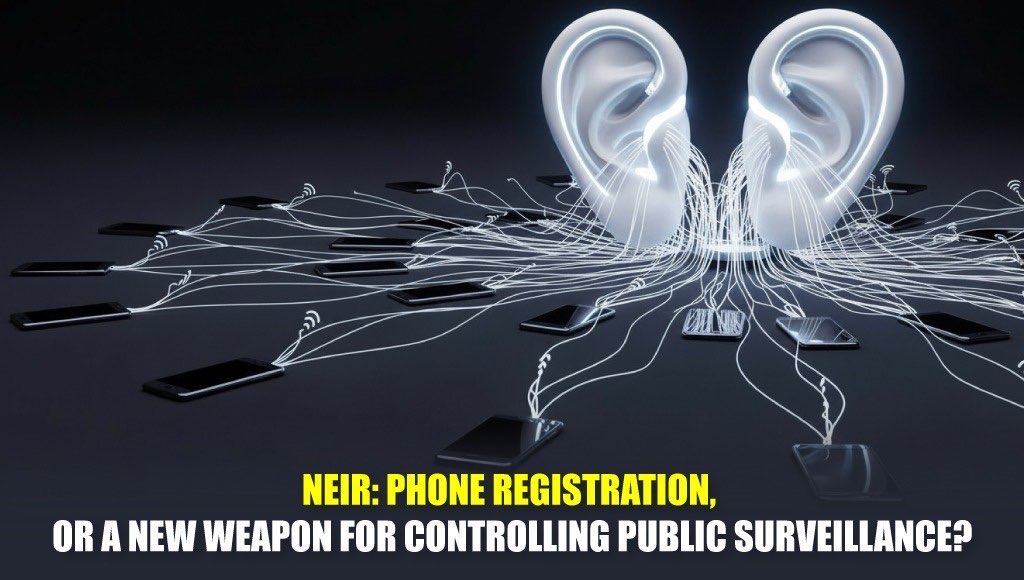
[NEIR: Phone registration, or a new weapon for controlling public surveillance?]
So the question is: whom does this NEIR system really serve? Ordinary people? Absolutely not. It serves the interests of those syndicates that want to control the market. If someone buys a good-spec phone from Dubai for 30,000 taka, they’re now told it’s “illegal.” But if the same phone is sold by Walton or Symphony for 50,000 taka, it suddenly becomes “domestic industry.”
Why do people buy phones through informal channels? Because of price. A Samsung Galaxy S25 Ultra costs 200,000 taka in Bangladesh, while the same phone costs 150,000 taka in Dubai. Where does this 50,000 taka difference go? Into the government’s pocket, in the name of duties. And what’s done with that money? There’s no accountability.
Mr. Yunus’s government says it will build a “Smart Bangladesh.” But how can a country become smart when people have to spend three months’ income to buy a smartphone? Smartphones are no longer a luxury; they’re a part of daily life. A rickshaw puller using ride-sharing apps, a tailor taking online orders, a student attending online classes—all need a phone. But if phones are priced abnormally high, how can Digital Bangladesh exist?
What’s even more interesting is what this NEIR system actually enables. Every phone’s IMEI number can be linked to an NID, tracking who uses it, where, and when. Is this only to stop “stolen phones,” or is it a mass surveillance system? Today, the entire country’s internet can be shut down. Tomorrow, will it be possible to selectively shut down the phones of specific individuals?
What reason is there to trust a government that seized power with military backing, shoulder to shoulder with militants, and with foreign support? When they say “for the good of the country,” whose good are they talking about? Ordinary people’s, or the business groups that funded them?
The fact that 53 phones can be registered under someone’s name without their knowledge has no explanation. No accountability. Because this government has no obligation to answer to the people. They weren’t elected. They came to power through bloodshed.
Does any other country in the world have such an irrational system? In America, don’t people import phones? In Europe, don’t people bring phones from abroad? Is there this kind of harassment there? No. Because in those countries, governments are servants of the people, not masters over them. Here, the government thinks it owns the people.
What’s happening through the NEIR system is a new form of plunder. Earlier, buying a stolen phone was a problem. Now, even if an ordinary person legally brings a phone from abroad for personal use, they’re put in the same category. Why? Because it’s supposedly harmful to “domestic industry.” Which domestic industry? The one that only turns screwdrivers?
Users flag anomalies as NEIR portal shows dozens of phones registered against one NID
Most importantly, if the goal were truly to protect domestic industry, it should be done through competition, not by shutting down the market. India, Vietnam, and Thailand all allow foreign phones, yet they’ve kept their local companies competitive through quality and price. We’re not doing that—we’re closing the market. That’s nothing but a syndicate.
If someone now tells me, “You don’t want what’s good for the country,” I’ll say very clearly: no, I don’t want what’s good for this country—if by “country” you mean Mr. Yunus’s illegitimate government and their syndicates. I want what’s good for a country where an ordinary person can buy a good phone with their hard-earned money without harassment. I want a country where the government is a servant of the people, not their master.
But that country doesn’t exist right now. What exists is an illegitimate system of rule that keeps placing one burden after another on the people. The NEIR system is just one example. Many more will come. And as time goes on, control will only increase. Because a government that came to power at gunpoint will want to stay in power at gunpoint—and for that, it needs surveillance, control, and repression.
So no matter how nicely the NEIR system is packaged, the reality is that it’s a tool—either for plunder, or for surveillance. Or both.