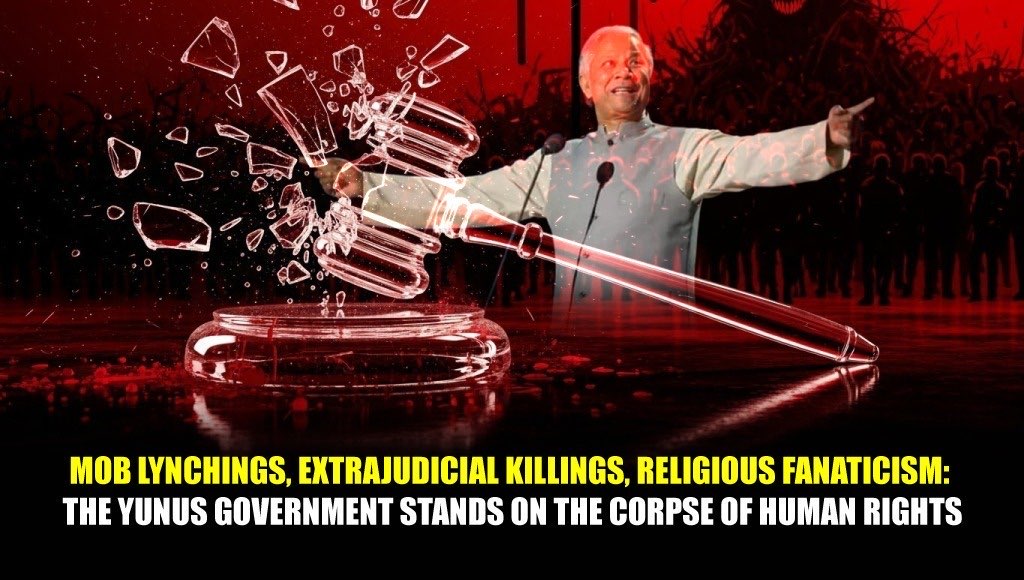

Reading the recently published human rights report of Ain o Salish Kendra is genuinely chilling. In 2025, 197 people were killed in mob lynchings. In 2024 the number was 128. That means deaths from mob violence increased by almost 54 percent during the tenure of the interim government. In Taraganj, Rangpur, two innocent people were beaten to death on suspicion of stealing a van, while the police stood by and watched. Is this normal? Can this happen in any civilized state?
Since Muhammad Yunus and his so-called reformist government came to power, the level of disorder, anarchy, and lawlessness that has emerged in the country is almost unprecedented in Bangladesh’s history. This illegal structure, installed through a carefully planned coup in July–August to overthrow an elected government, is clearly taking the country in a dangerous direction, and it is no longer possible to hide that fact.
The brutality being carried out in the name of “Tawhidi crowds” makes it feel as though the country has returned to the Middle Ages. Corpses are being exhumed from graves and burned. Members of the Baul community are being attacked. Cultural centers are being vandalized. Freedom fighters are being humiliated. And all of this is happening in front of the police, right under the nose of the administration. What is the government doing? Nothing. They are simply watching as the country is turned into a hell of religious frenzy.
This interim structure under Muhammad Yunus is not really a government at all. It is a failed, incompetent, and directionless group with no public mandate and no capacity to govern. Since coming to power, they have done only one thing: pursued revenge against the previous government. And in the space created by this politics of revenge, the country has sunk into bloodshed, violence, and chaos.
In a country where 107 people die in prison in a single year, there can be no rule of law. In 2024 the number was 65; in 2025 it jumped to 107. The hanging body of former chairman Saidur Rahman Sujon, the handcuffed corpse of former minister Nurul Majid Mahmud Humayun — are these normal incidents? They are naked evidence of a failed, cruel, and vindictive system.
Extrajudicial killings have not stopped; they have increased. In 2024, 21 people were killed in so-called “crossfire” incidents; in 2025 the number rose to 38. “Crossfire,” “gunfight,” “encounter” are just polite names for extrajudicial executions. Muhammad Yunus and his team speak of democracy, reform, and human rights, but in practice they are amplifying the worst abuses of the previous government.
The picture of political violence is even more horrifying. In 401 political clashes, 102 people were killed and nearly 5,000 injured. Internal conflicts within the BNP alone killed 39 people and injured 2,380. Is this what a stable state looks like? This is the image of a failed state, where there is no real government, only a ruling faction consumed by its own infighting.
The statistics on attacks against journalists show what this government understands by freedom of expression. In one year, 381 journalists were assaulted or harassed. Three were killed, and four were found dead under mysterious circumstances. And most disgracefully, the attacks on the offices of Prothom Alo and The Daily Star on 18 December mark one of the darkest chapters in Bangladesh’s media history. What did the government do then? Nothing. They silently watched as the offices of the country’s two leading newspapers were set on fire.
The condition of religious minorities is even more tragic. There were 42 attacks on the Hindu community, 33 homes damaged, 36 homes set on fire, and 64 idols vandalized. Can this happen in a civilized, democratic state? The Yunus government speaks of protecting minorities, but in reality it has silently tolerated these abuses. There has been no justice, no punishment, and minorities now feel like foreigners in their own country.
The vandalism of Liberation War memorials and repeated attacks on the Bangabandhu Memorial Museum are not isolated incidents. They are part of a planned effort to erase the history, spirit, and ideals of Bangladesh’s Liberation War. And the Yunus government has taken no firm action against this destruction, perhaps because those carrying it out are the very forces that put them in power.
Shahdeen Malik has said that this failure reflects the government’s overall failure. That is exactly right. The Yunus-led structure has failed to maintain law and order, failed to protect human rights, failed to protect minorities, failed to safeguard media freedom, and failed to bring political stability. In fact, it has failed on every front. The only thing it knows how to do is cling to power at any cost.
The horrific picture presented by Ain o Salish Kendra’s report is only part of the reality. The true situation may be even worse, because many incidents go unreported and many abuses never see the light of day. In a state of fear created by this government, people are afraid even to speak about their suffering.
This government has no legitimacy, no public support, and no moral right to rule the country. It came to power through a coup and survives on the backing of the military and extremist groups. It is turning the country into a fanatical, intolerant, and violent society where there is no rule of law, no concept of human rights, and no democratic values.
Bangladesh now stands at a dangerous crossroads. Either the country will return to being a democratic state based on the rule of law, or it will sink further into darkness. Given the way Muhammad Yunus and his team are acting, the second outcome looks far more likely. They are truly turning the country into hell. The question is: when, and how, will Bangladesh emerge from this hell?
⸻