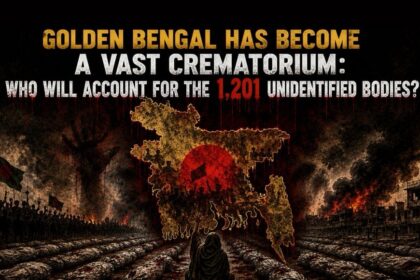


The Bangladesh Election Crisis has reached a critical stage as preparations move forward for an election designed to exclude the Awami League—the country’s most electorally supported and politically legitimate party since 2008. This exclusion is not accidental. It is the final act of a carefully constructed political conspiracy aimed at rewriting electoral reality and erasing public mandate.
If such an election is held, two outcomes are inevitable. First, the BNP will secure victory by default, facing no genuine electoral competition. Second, individuals linked to the violent events of July will be guaranteed parliamentary seats regardless of party affiliation. This process cannot be described as democratic by any standard; it is a managed redistribution of power.
Voter Disenfranchisement at the Core of the Bangladesh Election Crisis
Any expectation of a fair election under these conditions is illusory. An estimated 40 percent of Awami League voters will boycott the polls outright. Another 20 percent—politically conscious citizens who recognize the election as a sham—are also expected to abstain. This means nearly 60 percent of the electorate is excluded before voting even begins.
Among those willing to participate, many will face logistical, security, or administrative barriers to reaching polling centers. Minority communities, Awami League supporters, and economically vulnerable citizens are likely to be coerced or threatened into voting. Even then, genuine voter turnout is unlikely to exceed 30 percent—potentially the lowest in Bangladesh’s electoral history.
Manufactured Turnout and Electoral Manipulation
The public will not be allowed to see this reality. Through coordination between participating parties, civil administration, and military and civilian forces, large-scale ballot stuffing is expected to occur before polling begins. Artificial crowds will be staged at polling centers to mislead domestic observers and the international community, followed by official announcements claiming turnout exceeded 70 percent.
Such practices represent a complete breakdown of electoral integrity and further deepen the Bangladesh Election Crisis.
The July Movement and the Return of Anti-Liberation Forces
The so-called July movement, launched under the banner of democracy and quota reform, has revealed itself as a revival of anti-Liberation War and anti-independence forces. This will become unmistakably clear when those who once accused the Awami League of rigging elections are exposed as architects of the most fraudulent election in Bangladesh’s history.
This is not reform. It is deception carried out under the cover of democratic language.
The “BNP Is Better Than Jamaat” Narrative Explained
A coordinated propaganda campaign is now promoting the idea that “BNP is better than Jamaat.” While it is true that BNP’s founder was a freedom fighter and Jamaat opposed Bangladesh’s independence, the narrative serves a deeper political purpose.
Jamaat holds less than 10 percent popular support and poses no realistic electoral threat. The push to redirect Awami League voters toward BNP is not about blocking Jamaat—it is about ensuring a predictable power structure that benefits opportunistic elites, corrupt politicians, business syndicates, and compromised media and cultural figures. These groups thrived during BNP’s 2001–2006 rule and expect similar privileges if BNP returns to power with Jamaat as a junior partner.
Extremism Will Not Disappear Under BNP Rule
The belief that BNP’s rise would prevent extremist expansion is deeply flawed. The surge of radical Islamist influence did not emerge overnight; it developed over years. If the Awami League, despite its governance capacity, struggled to fully contain it, there is little reason to believe BNP—historically aligned with Jamaat—will either prevent or resist it.
Why an Inclusive Election Was the Only Viable Path
Democracy does not allow one party to rule indefinitely. After fifteen years in power, an Awami League defeat through a fair, inclusive election would have been legitimate and stabilizing. In fact, following some decline in popularity, BNP could have returned to power organically through a competitive electoral process.
Instead, the events of August 5, 2024, dismantled not just a government but the democratic foundation of Bangladesh. The deliberate exclusion of the Awami League mirrors the “minus-two” formula of 2006, aiming to neutralize both major parties and install an undemocratic power structure for long-term control.
Bangladesh Cannot Function Without the Awami League
The central objective of the current propaganda is to convince citizens that Bangladesh can function without the Awami League. This is historically and politically false. Bangladesh was born through the Awami League. Its independence, constitutional identity, and democratic evolution are inseparable from the party’s role.
Whether in government or opposition, Bangladesh’s political system cannot remain stable without the Awami League’s participation.
The Bangladesh Election Crisis as a Threat to Sovereignty
An election organized by an unelected interim authority, backed by military power, foreign funding, and Islamist militant influence, is not merely illegitimate—it is a direct threat to Bangladesh’s sovereignty. Without a universal, inclusive election involving all major parties, the country risks sliding into long-term instability and democratic collapse.
The Bangladesh Election Crisis is no longer just about voting. It is about the survival of the state itself.