
When Bangladesh burned in July 2024 and blood ran through its streets, few imagined that the real catastrophe would begin afterward. The violent overthrow of an elected government through a planned coup did not restore order—it dismantled the state itself. What followed has been an accelerating human rights collapse under the Yunus regime, with no visible path toward recovery.
More than a year and a half later, the interim administration led by Muhammad Yunus has failed to restore peace or security. Instead, Bangladesh has descended into a climate of fear, lawlessness, and normalized violence. Bodies are found floating in rivers, citizens die in custody, and mob killings occur in plain sight—while the government remains silent and inactive.
Rising Unidentified Bodies Signal State Collapse
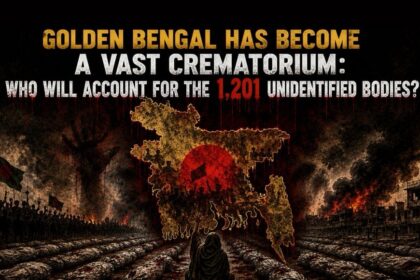
The scale of unidentified deaths has reached alarming levels. In October alone, 66 unidentified bodies were recovered. September recorded 52 more. These bodies were found in rivers, roadside ditches, abandoned areas, bridges, and canals—each death unanswered, uninvestigated, and forgotten.
In Khulna, river police recovered 50 bodies from waterways in a single year. In Dhaka’s Buriganga River, four bodies surfaced in one day—two with their hands bound. These are not isolated incidents; they are evidence of a systemic breakdown in law enforcement and accountability under the Yunus regime.
Custodial Deaths Turn Prisons Into Graveyards
Bangladesh’s prisons have effectively become death chambers. In just one and a half months, 112 people died in custody. In Bogura Jail, four Awami League leaders died simultaneously, without investigation or public accountability. Deaths in police custody continue to be reported, yet no meaningful inquiries follow.
The message is unmistakable: under the current regime, human life holds little value.
Mob Violence and Extremism Fill the Power Vacuum
Mob violence has surged at unprecedented levels. Within ten months, 140 people were beaten to death in 256 separate incidents. Attacks on shrines, dargahs, and Baul practitioners have become routine. In Comilla, four shrines were attacked in a single village. In Rajbari, a man’s body was exhumed from a grave, dragged to a highway, and burned.
Even more disturbing, lawyers inside the Manikganj court premises openly chanted slogans calling for Bauls to be hunted down and killed. Such scenes reflect not merely social unrest, but the total collapse of the rule of law.
Political Killings and Extrajudicial Deaths Continue Unchecked
Political violence has claimed at least 281 lives, while 26 documented cases of extrajudicial killings have raised serious concerns about police and military involvement. Despite credible allegations, no investigations have been launched, and no justice has been delivered.
Instead, mass false cases are being filed against innocent citizens. Draft charge sheets are circulated like commodities, with victims asked to pay money to avoid prosecution. Homes and businesses are seized under political cover, turning repression into an organized enterprise.
International Human Rights Warnings Ignored
Human Rights Watch has confirmed that the interim government has failed to protect basic human rights. Its findings highlight arbitrary detentions of political opponents, stalled institutional reforms, and routine harassment of women’s rights activists, journalists, and LGBTQ community members by religious extremists.
Despite these warnings, the Yunus regime has taken no corrective action.
A Government That Sees Everything and Does Nothing
As chief adviser, Muhammad Yunus has repeatedly claimed that adequate security measures are in place. In January, his press wing asserted that shrines were protected. In reality, attacks only intensified.
This raises a fundamental question: why does the government refuse to act?
The answer lies in the origins of this regime. A government installed through foreign funding, militant Islamist support, and military backing—after orchestrating the July 2024 riots—has little incentive to protect ordinary citizens. The same forces that engineered the unrest are now reshaping the country for their own interests, leaving no space for public safety or human dignity.
From Microcredit Exploitation to National Suffering
Yunus’s long-criticized reputation as a ruthless moneylender now finds expression in governance. The same extraction imposed on the poor through microcredit is now being imposed on the entire nation. Bangladesh is being turned into a landscape of fear, silence, and suffering.
Human rights defenders have sounded the alarm. Nur Khan Liton warns that the situation deteriorates daily without visible government response. Saidur Rahman confirms that there has been no change in mindset, behavior, or institutional practice regarding human rights. When veteran activists lose hope, the implications are grave.
An Engineered Chaos Without Accountability
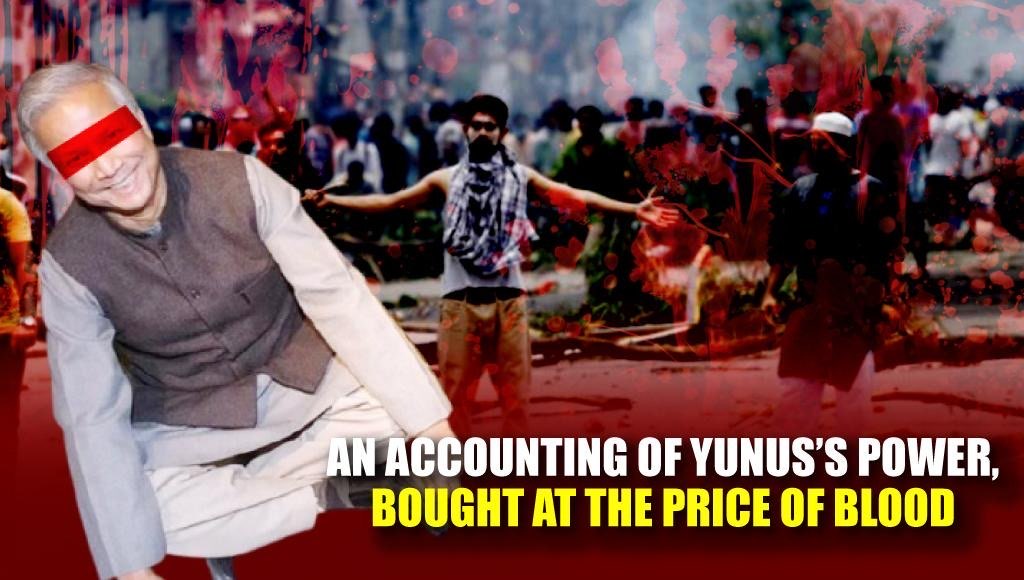
Expecting justice from a government born of illegality is an illusion. The blood shed during the July riots has not dried; it is being replenished every day—in prisons, on streets, and in rivers. Each death is another entry in the ledger of the Yunus regime.
Bangladesh is no longer on a democratic path. It is trapped in a deliberately engineered chaos—without rule of law, without security, without human rights. The most dangerous aspect is that this reality is concealed behind the image of a Nobel laureate.
Behind that mask lies a regime whose actions speak clearly enough—at devastating cost to the people of Bangladesh.