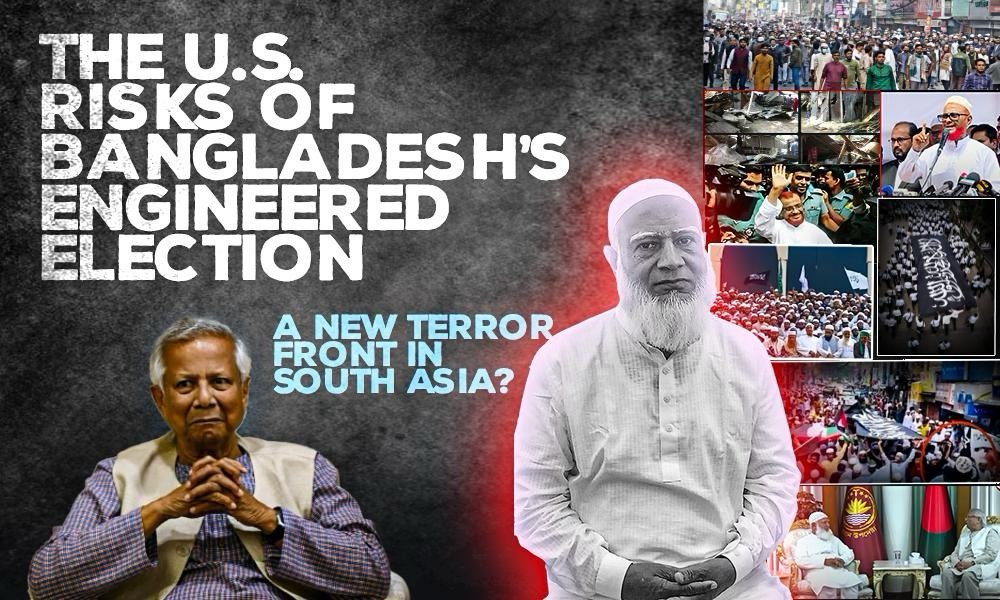

Bangladesh’s February 2026 election is at serious risk of becoming an engineered and exclusionary process under the Yunus-led interim government. Rather than functioning as a neutral caretaker, the administration has actively promoted a “Yes” referendum, restricted political competition, and signaled a clear intent to shape electoral outcomes.
Yunus running own campaign as Bangladesh parties rally for polls.
Bangladesh’s engineered election is creating a clear pathway for Jamaat-e-Islami to gain power. By weakening secular safeguards, tolerating Islamist mobilization, and sidelining competitive political forces, the interim government appears less concerned with preserving democracy than with shaping a favorable outcome. A Jamaat-influenced government would threaten Bangladesh’s secular constitutional order and embolden extremist networks.
Bangladesh’s Political Quagmire Under Yunus’s Interim Government
Such a shift carries serious consequences for the United States. The rise of political Islamism in a strategically vital South Asian country would heighten terrorism risks, destabilize the region, and strain global counterterrorism cooperation. Bangladesh’s engineered election, therefore, represents not only a democratic crisis but a growing security challenge with direct implications for U.S. interests and international stability.
How the Yunus Government Is Engineering the Election and Setting the Stage for Jamaat
Bangladesh’s interim government has moved beyond its caretaker mandate into overt political engineering. Since assuming power in August 2025, the Yunus administration has pursued selective reforms, partisan signaling, and calculated inaction that weaken democratic competition. These choices are reshaping the electoral environment in ways that sideline secular forces while quietly enabling Islamist actors, most notably Jamaat-e-Islami, to benefit from a managed transition.
- Promotion of the “Yes” Referendum: The government’s open advocacy for a “Yes” vote in the constitutional charter referendum represents a clear breach of caretaker neutrality. Official platforms linked to the Chief Adviser’s Office and public statements by interim officials have framed the referendum as a necessity rather than a choice. Instead of facilitating debate, state resources have been used to steer opinion. The referendum thus functions less as a democratic exercise and more as a political filter ahead of the February 2026 election.
- Political Exclusion and Administrative Bias: At the same time, major political parties have been sidelined through legal ambiguity, delayed timelines, and selective enforcement. Despite repeated assurances, no credible roadmap for an inclusive election has emerged. Reforms are continually cited to justify postponement, reinforcing concerns that a delayed and fragmented election is being engineered to limit genuine competition.
- Toleration of Islamist Mobilization: While mainstream political activity faces constraints, Islamist groups have operated with notable freedom. On 7 March 2025, the banned organization Hizb-ut-Tahrir publicly mobilized in Dhaka, calling for an Islamic caliphate, an event that would have been unthinkable under previous governments. Jamaat-aligned actors have similarly expanded street presence with limited resistance, signaling selective enforcement rather than incapacity.
- Weak Response to Rising Extremism: Since late 2025, Bangladesh has seen attacks on media outlets, intimidation of journalists, mob disruptions of cultural events, and escalating Islamist rhetoric. The government’s response has been muted and inconsistent. By downplaying these trends instead of confronting them, the interim administration has allowed extremism to normalize, further entrenching conditions favorable to Jamaat’s ascent.
What Happens if Jamaat-e-Islami Comes to Power
If Jamaat-e-Islami ascends to power through an engineered and exclusionary election, Bangladesh would undergo a decisive ideological and institutional shift. This would not be an abrupt rupture, but the predictable outcome of an interim government that has weakened secular safeguards while allowing Islamist momentum to grow unchecked.
1. Shift from Secular to Islamist Governance
Jamaat’s resurgence is already visible in public rallies, mosque-centered mobilization, and coordinated street protests since late 2025. Historically, Jamaat has opposed Bangladesh’s secular constitutional framework and rejected the legacy of the 1971 Liberation War. During its previous period of influence (2001–2006), Jamaat leaders held cabinet positions and pushed faith-based governance narratives.
A return to power would likely revive efforts to reshape education policy, cultural expression, and state institutions along ideological lines rather than constitutional pluralism.
2. Weakening of Rule of Law and Counter-Extremism
Bangladesh’s counterterrorism capacity has previously depended on strong political will. Between 2016 and 2021, aggressive action dismantled ISIS-inspired cells following the Holey Artisan Bakery attack. In contrast, recent reports indicate inconsistent enforcement against radical groups and visible restraint toward Islamist mobilization.
Sheikh Hasina slams Yunus, flags religious extremism in Bangladesh
Under Jamaat influence, given its historical opposition to anti-extremism crackdowns, preventive policing and intelligence coordination would likely erode, turning state institutions from barriers against radicalization into sites of ideological compromise.
3. Persecution of Minorities and Human Rights Erosion
Jamaat’s record on minority rights is well documented. Its leaders were implicated in violence against Hindu communities during the 1971 war, and its cadres were linked to post-election attacks on minorities in 2001.
Since late 2025, Islamist protests opposing women’s legal reforms, cultural programs, and free expression have increased. If politically empowered, Jamaat-aligned forces would be positioned to institutionalize this intolerance, accelerating pressure on religious minorities, journalists, women, and civil society actors.
4. Political Vacuum Exploited by Radical Actors
Exclusion of mainstream political forces has created a dangerous vacuum. Security analysts warn that hard-line groups thrive in transitional environments where legitimacy is weak and enforcement is selective. The reappearance of banned organizations such as Hizb-ut-Tahrir during the current interim period underscores this risk.
A Jamaat-influenced government would further normalize radical actors, allowing them to embed within social, educational, and political structures. By failing to close these gaps, the interim government is not merely mismanaging the transition; it is enabling extremist consolidation.
Threats to United States Security
Bangladesh’s current political trajectory poses risks that extend far beyond its borders. The consolidation of power through a distorted electoral process, combined with the interim government’s calculated tolerance of Islamist actors, has begun to alter the country’s security profile in ways that directly implicate U.S. national interests. What is unfolding is not an abstract governance failure, but a convergence of political engineering and ideological accommodation with serious security consequences.
As Bangladesh Reinvents Itself, Islamist Hard-Liners See an Opening
1. Bangladesh as a Potential Safe Haven for Terrorist Networks
A legitimacy-weakened state with selective enforcement creates space for extremist revival. Since early 2025, banned groups have reappeared publicly with little resistance. Hizb-ut-Tahrir, outlawed for extremism, has run open propaganda campaigns promoting Islamic governance and anti-Western narratives, culminating in a 7 March 2025 Dhaka rally calling for a caliphate.
Banned Extremist Group Hizb ut-Tahrir Holds ‘March for Khilafat’ Rally in Dhaka
This permissive climate risks enabling militant regrouping, including:
- Harkat-ul Jihad al-Islami Bangladesh (HUJI-B), previously linked to Al-Qaeda–associated networks
- Reopened recruitment pipelines and cross-border coordination
Such environments degrade intelligence visibility and directly undermine U.S. counterterrorism objectives.
2. Direct Threats to U.S. Citizens and American Interests
Bangladesh has demonstrated capacity for high-impact attacks on Western targets. The 2016 Holey Artisan Bakery attack, inspired by ISIS, killed foreign nationals, including Americans, and required sustained counterterrorism pressure to contain.
A Jamaat-influenced political order would likely weaken:
- Preventive policing and intelligence coordination
- Protection for U.S. diplomats, NGOs, businesses, journalists, and travelers
Recent mob attacks on media investigating extremism signal declining deterrence and growing tolerance for intimidation.
Tulsi Gabbard warns Bangladesh of Islamist caliphate threat.
3. International Terrorism Linkages
Bangladeshi extremist actors have established links with ISIS-aligned cells and Lashkar-e-Taiba (LeT). Post-2016 investigations confirmed ideological alignment and facilitation channels.
If these networks are allowed to regenerate, Bangladesh risks becoming a transnational terrorism node, extending threat exposure to:
- Europe
- The Middle East
- The Indo-Pacific
4. Regional and Global Instability Affecting U.S. Interests
Rising extremism would strain relations with the United States, India, and Western partners, weakening cooperation on intelligence and maritime security. Instability in the Bay of Bengal directly impacts the U.S. Indo-Pacific strategy.
Likely spillovers include:
- Cross-border militancy
- Refugee pressures on India and Myanmar
- Ideological diffusion into Southeast Asia
5. Diversion of U.S. Counterterrorism Resources
A destabilized Bangladesh would force the U.S. to redirect:
- Intelligence and surveillance assets
- Counterterrorism engagement in South Asia
This would dilute focus on Pakistan, Afghanistan, and the Middle East, increasing long-term strategic costs. Prevention now is far cheaper than containment later.
6. Erosion of Secularism and Democratic Institutions
Jamaat’s rise would accelerate the erosion of Bangladesh’s secular constitutional order. Independent media, civil society, and opposition voices would face growing intimidation.
The resulting polarization raises risks of:
- Internal unrest
- Authoritarian consolidation
- Extra-constitutional intervention
Each outcome directly contradicts U.S. interests in democratic stability and regional security.
Why the United States and International Bodies Must Stop Bangladesh’s Engineered Election
The risk is no longer theoretical. An exclusionary election in Bangladesh is evolving into a security concern with regional and global consequences. Inclusive elections are not merely a democratic standard; they are a security necessity.
When mainstream political participation is restricted, organized Islamist groups gain a structural advantage. Preventing the emergence of an extremist-permissive environment in South Asia directly protects U.S. homeland security and broader international stability.
Key risks of allowing a managed election include:
- Legitimization of Islamist actors through engineered political outcomes
- Heightened threats to U.S. citizens, diplomats, NGOs, and businesses
- Renewed space for transnational extremist networks to regroup and recruit
- Destabilization of the Bay of Bengal and the Indo-Pacific security framework
Upholding democratic norms also preserves the credibility of the U.S., EU, and UN foreign policy. Quiet acceptance of a controlled election would weaken international standards and signal that outcomes matter more than process.
Most critically, early intervention is more effective than crisis management. The warning signs, resurgent banned groups, political exclusion, intimidation of media, and ideological mobilization are already visible.
International scrutiny and targeted diplomatic pressure are therefore essential. Stopping an exclusive election in Bangladesh is not interference; it is prevention. The window for action remains open, but it is narrowing.