
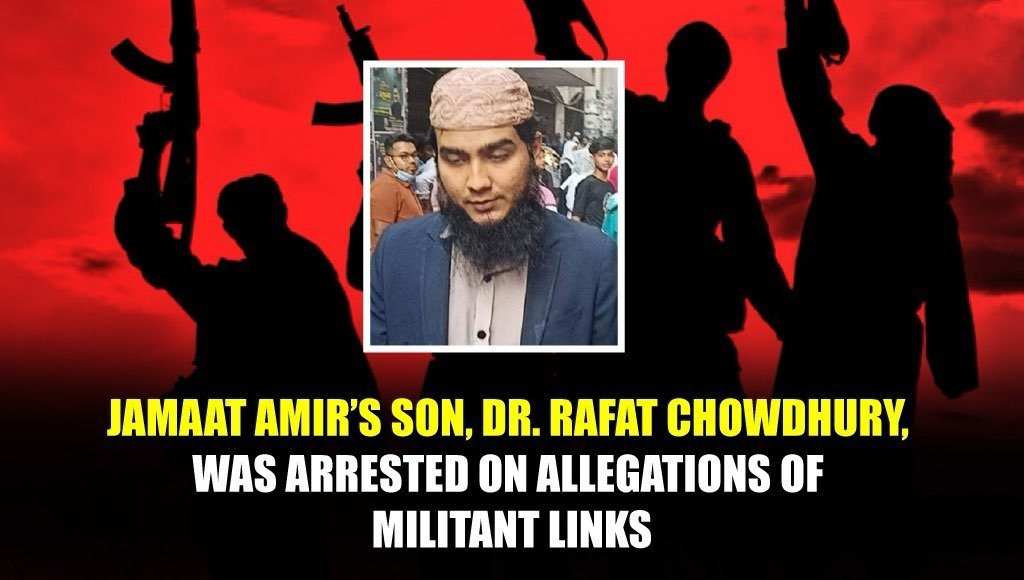

On 9 November 2022, Dr. Rafat Chowdhury—the son of Jamaat-e-Islami’s current Amir, Dr. Md. Shafiqur Rahman—was arrested on allegations of involvement in militancy by the Bomb Disposal Team of the Counter Terrorism and Transnational Crime (CTTC) Unit of the Dhaka Metropolitan Police.
After the arrest, the then Additional Deputy Commissioner (ADC) of CTTC, Rahmat Ullah Chowdhury, told journalists that Dr. Rafat Chowdhury had been serving as the chief coordinator for the Sylhet region of the banned militant organization Ansar Al Islam. He had long been accused of running recruitment and outreach activities aimed at radicalizing religiously inclined youth and motivating them toward extremist and jihadist ideology.
Investigations further revealed that in 2021, Dr. Rafat Chowdhury had established contact with two armed groups active along the Myanmar border—the Arakan Rohingya Salvation Army (ARSA) and the Rohingya Solidarity Organization (RSO)—with the intention of participating in so-called “jihad” in support of the Rohingyas. According to CTTC sources, investigators also uncovered information about meetings with RSO leaders in the Naikhongchhari border area of Bandarban during that period.
However, the most alarming issue now emerging is the claim from various sources that after the political changes in July–August, Dr. Rafat Chowdhury was quietly released from prison after 5 August. So far, no formal news regarding this release has appeared in mainstream media. Concerned quarters allege that this was not an isolated incident; around the same time, several other individuals accused of militancy were also released from jail.
Security analysts say the consequences of such releases are already being reflected in worrying incidents across the country. A few weeks ago, two people were killed in an explosion while making a bomb in Shariatpur. Additionally, at least four people were injured in a suicide bomb blast at a madrasa in Keraniganj.
Experts warn that these incidents indicate how easing strict monitoring and legal processes against militancy could once again create serious security risks. They have called for transparency and accountability in the release, rehabilitation, and monitoring of individuals accused of militancy.