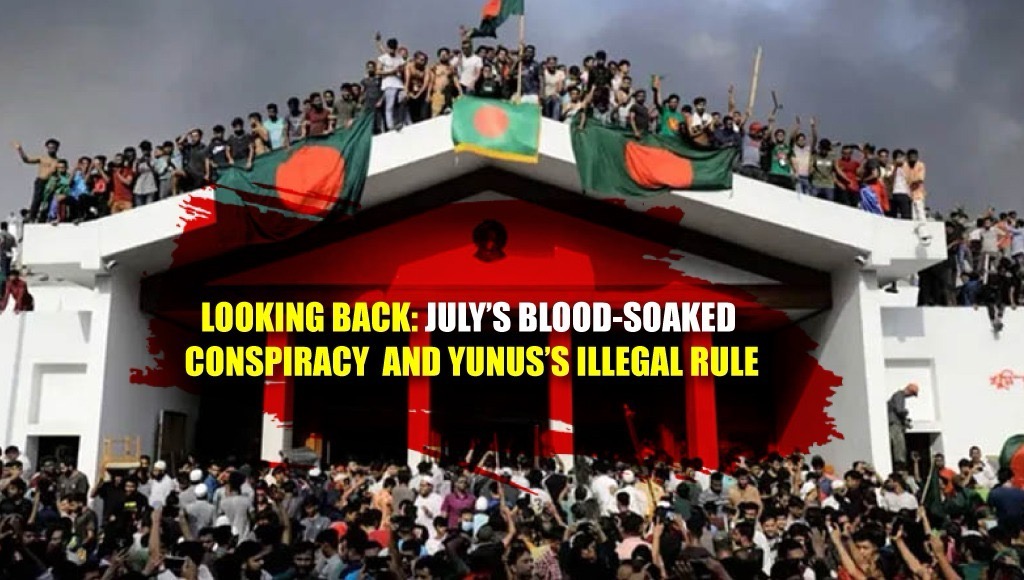

What unfolded on Bangladesh’s streets in July 2024 cannot, by any standard, be described as a spontaneous student movement. It was a carefully orchestrated state coup, driven by international networks, fundamentalist militant groups, and certain wayward forces within the country. This drama of toppling an elected government and installing a usurious financier named Muhammad Yunus in power was not merely a violation of the Constitution. It was part of a long-term plan to undermine the very foundations of the Bangladeshi state.
Most of the young people who poured into the streets during the July riots had no idea whose puppets they were dancing as. Before them was placed an apparently just demand, quota reform. Behind the scenes, however, an entirely different game was underway. The main actors in this game were Jamaat-e-Islami and the BNP, parties that for the past fifty years have tried to dismantle every democratic achievement of Bangladesh. Jamaat, the organization that collaborated with the Pakistani occupation forces in 1971 to massacre hundreds of thousands, rape women, and murder intellectuals, is today a partner in power in the name of reform. The BNP, a party born inside cantonment walls, from the bloodstained hands of the autocrat Ziaur Rahman, under whose rule corruption and terrorism became state policy, now sits wearing the mask of democracy.
A neutral analysis of the July events makes one thing clear: this was not a sudden eruption. First came the demand for quota reform, which on the surface seemed reasonable. But when the government sought dialogue, when the courts delivered rulings, violence suddenly erupted. Burning police boxes, destroying state property, killing innocent people. Are these signs of a peaceful movement? Those throwing Molotov cocktails, beating police officers to death, setting public property ablaze. Were they really students, or trained cadres?
Consider Muhammad Yunus himself. Many see him as a great man simply because he received the Nobel Prize. The reality is that Yunus is nothing more than an interest-charging moneylender. Under the banner of Grameen Bank, he ran a carefully designed business model that trapped the poor in cycles of debt. Numerous studies document how so-called microcredit programs ensnared poor Bangladeshi women in lifelong indebtedness. Many families remain permanently burdened by these loans. Yunus’s model was celebrated in Western countries because it demonstrated how profit could be extracted in the name of charity. That is why he was awarded the Nobel Prize. He managed to put a human face on capitalism.
This same Yunus has now been installed as Bangladesh’s chief adviser, without reference to any constitutional provision. In a democratic country, an elected government was removed and an unelected individual placed in power. This is not reform. It is a coup. And the support of sections of the military behind this coup is no longer a secret. When armed forces, whose duty is to protect national borders, become involved in politics, Bangladesh knows well what follows. The country has not forgotten where it ended up under the military regimes of Ziaur Rahman and Hussain Muhammad Ershad.
There are countless indications of foreign funding and conspiracy behind the July riots. It strains belief that such organized violence could erupt simultaneously across the country without planning. The weapons used, the scale of destruction, all point to massive financial backing. Where did this money come from? Which forces want Bangladesh destabilized? In whose interest was it to remove a stable, elected government? Searching for answers to these questions reveals many uncomfortable truths.
Jamaat-e-Islami and the BNP are the greatest beneficiaries of this conspiracy. Jamaat, which opposed the creation of Bangladesh in 1971 and fought on Pakistan’s side, is now a partner in state power. From positions within the education ministry, they are attempting to erase the history of the Liberation War from textbooks. They are attacking culture and trying to weaken Bengali identity. They understand that to destroy a nation, one must first destroy its history and culture. The BNP, once crowned world champions of corruption, under whose rule the country became a bottomless basket, now speaks of reform. What greater joke could there be?
What has unfolded in Bangladesh since July is a planned process of state destruction. First came attacks on national symbols. Cricket, a major source of national pride, is being targeted. Shakib Al Hasan, the country’s most successful cricketer, is being branded a traitor. Why? Because he was a Member of Parliament from the Awami League. By that logic, millions who voted for the Awami League could also be called traitors. There are demands to rename the Sher-e-Bangla Stadium in Mirpur, a venue of countless glorious moments in Bangladesh’s cricket history. The objective is singular: to destroy national confidence and pride.
The education system is under attack. Bangabandhu’s name is being reduced in history books. The role of the Liberation War is being diminished. They know that if the new generation does not know its history, it can be easily misled. Culture is under attack as well. Celebrations like Pahela Baishakh and the Bengali New Year are being portrayed as “Hinduized.” Statues are being broken, memorials attacked. All of this is part of a long-term plan to turn Bangladesh into a communal, intolerant, backward state.
Many of the young people who took to the streets in July may genuinely have wanted reform. But they were used. A dream was shown to them, while the reality was entirely different. Those now in power are not reforming anything. They are pursuing vengeance. Political opponents are being arrested, tortured, jailed. Courts are being used as political tools. Media freedom is being stripped away. Journalists and intellectuals who criticize this illegal government are being attacked. This is not democracy. It is fascism.
Bangladesh is a country born through blood. In 1971, it achieved independence through the blood of three million martyrs and the violated honor of two hundred thousand women. The principal enemies of that independence were the Pakistani military and their local collaborators: Jamaat, Razakar, Al-Badr, and Al-Shams. Today, those same forces have returned to power. They want to erase the spirit of the Liberation War and turn Bangladesh into a religious fundamentalist state like Pakistan. Pakistan was born in 1947 in the name of religion. What is its condition today? Terrorism, extremism, economic misery, military rule. Is Bangladesh being pushed in the same direction?
Since the July riots, Bangladesh’s economy has been collapsing. Investment has stalled. Foreign investors are leaving. The garment sector, the backbone of the economy, is seeing declining orders because Bangladesh is now labeled an unstable country in global markets. Tourism has collapsed. Reserves are shrinking. The currency is weakening. Prices are rising. The cost of living for ordinary people has increased. Yet those in power are indifferent. They are busy taking political revenge and securing their own interests.
Persecution of minorities has increased. Hindus, Buddhists, and Christians now live in fear. Their homes, temples, and businesses are under attack. Though the Constitution promises equal rights, in practice they are being pushed into second-class citizenship. This too is deliberate. To build a religion-based state, minorities must be suppressed.
The question now is how Bangladesh will emerge from this crisis. The answer is not simple. Once a country’s institutions are dismantled, rebuilding them takes time. Once divisions are created among people, healing them is difficult. But Bangladeshis have endured hardship before. They fought a war in 1971 to gain independence. They overthrew the autocrat Ershad in 1990. They can do so again.
The illegal government currently in power knows its foundations are weak. That is why it is racing to consolidate control. Loyalists are being placed in the administration, the military, and the judiciary. They want to cling to power as long as possible without holding elections. They know that if elections are held, defeat is inevitable. Ordinary people have not accepted this illegal government. They may be silent for now, but resentment is building beneath the surface.
Yunus and his associates, who claim to be reformers, are in fact dragging the country further backward. Most of the commissions they have formed are ineffective and serve only as delay tactics. They have no long-term vision, only a desire to remain in power. They rely on support from the United Nations and Western countries. But international backing is never permanent. If not today, then very soon, they too will have to face reality.