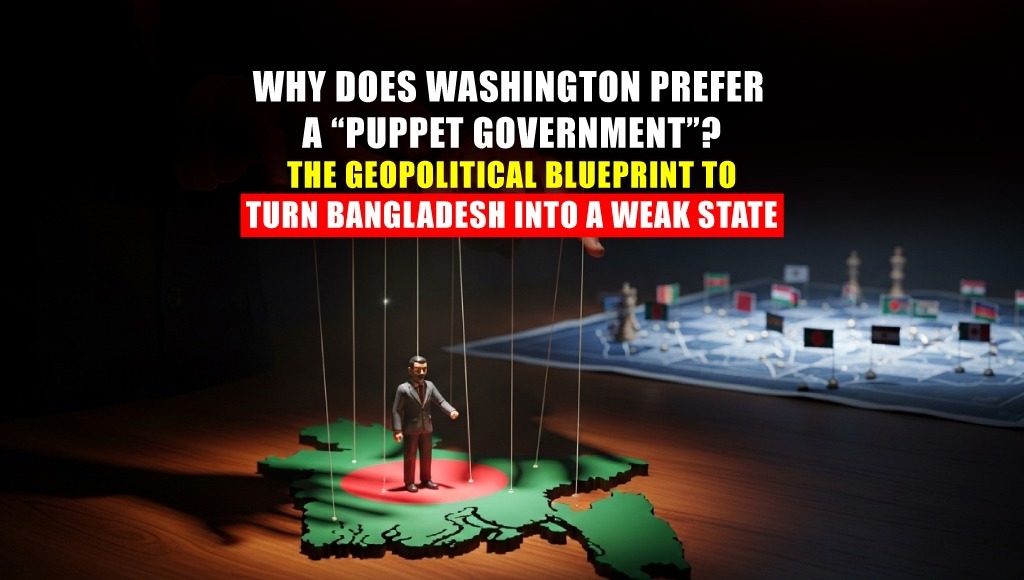

The Geopolitical Blueprint to Turn Bangladesh into a Weak State
Is Bangladesh’s politics still an internal matter today? Or has the country become a key piece on the strategic chessboard of global powers? Recent remarks by Sajeeb Wazed Joy leave little room to avoid this question. His analysis points clearly to one conclusion: Bangladesh is no longer facing just a political crisis—it is standing at the center of a carefully designed geopolitical project.
Speaking virtually at a book launch event in Kolkata, Joy presented not an emotional speech, but a stark lesson in South Asia’s security reality.
From Mass Movement to Violence: Old Script, New Stage
The quota reform movement was legitimate—there is no dispute about that. But South Asian history shows that every just movement often becomes the most effective entry point for weakening a state. Sri Lanka, Pakistan, even the Arab Spring—all demonstrate the same pattern: armed groups and foreign interests infiltrate popular movements.
According to Joy, Bangladesh witnessed exactly this. Islamist and militant networks penetrated the movement. Attacks on police stations, looting of weapons, widespread violence—these were not “spontaneous public outrage,” but tested methods of dismantling a state.
Unelected Government and the Release of Terrorists: No Coincidence
Over the past year and a half, the first major action taken by an unelected government in power was the release of convicted militants. The Holey Artisan attack, blogger murders, diplomatic killings—are these histories so easily forgotten?
There is a basic rule in global politics:
A government that releases terrorists ultimately stands on the support of terrorists.
This government is no exception. Legalizing mob justice, intimidating judges, burning media offices—these are not isolated incidents. They are indicators of an Islamist governance structure.
Not an Election, but a Controlled Performance
The election being organized by effectively banning the Awami League and all progressive forces is not an election—it is a managed transition. Only two forces have been left in the field: BNP and Jamaat.
This is not democratic competition; it is a process of deciding who will appear to rule—and who will actually control.
Tarique Rahman and Washington’s Calculation
This is the most explosive part of Joy’s allegation. His argument is straightforward: the reason Tarique Rahman is not prosecuted is not the absence of evidence, but the presence of leverage. A controlled prime minister is more useful than a convicted one.
History offers many examples. Latin America, the Middle East, Africa—wherever weak states were engineered, leaders were installed who could be kept “on the hook,” reminded with a single phone call where real power lies.
BNP’s sudden U-turn on the referendum issue reflects this reality. Supporting a referendum that is unconstitutional and already declared illegal by courts is not merely a political choice—it is an expression of geopolitical allegiance.
Postal Ballots: The Technology of Invisible Rigging
Why postal voting? Because it is the safest method of manipulation. No cameras. No journalists. No observers. Numbers will come from the Election Commission—and the world will accept them.
Videos from the Middle East showing mass ballot-filling are not rumors; they are warnings.
Jamaat’s Gain, the Region’s Loss
The absence of the Awami League directly benefits Jamaat. Their vote bank has not expanded, but the doors to power have opened. Dreams of a Sharia-based state, persecution of minorities, rehabilitation of militants—all return as real possibilities.
What Does This Mean for India?
Instability along the northeastern border, the return of Pakistani influence, and the re-emergence of Bangladesh as a safe haven for international militant networks.
A Final Warning
This is not party propaganda; it is a security alert. History shows that when Bangladesh was stable, South Asia was secure. And that period of stability was singular.
If today’s election is accepted as “normal,” the next five to ten years will see South Asia consumed by uncertainty and instability.
The question, therefore, is no longer political—it is strategic:
Can a weak, controlled, and extremism-dependent Bangladesh keep South Asia safe?
The answer, though uncomfortable, is clear.