
VGF rice. In other words, rice meant for the poor. Rice that the state allocates during disasters and crises for people who can barely put food in their stomachs. And now, 30 percent of that rice is being demanded. The honorable MP’s share. The conversation happens over the phone, gets recorded, and then goes viral. Meanwhile, the BNP leader says, “I fought for 17 long years to secure the rights of the people.”
Yes, fought indeed.
Fought for the right to take a share of the food from the mouths of the poor.
What happened in Kaliganj of Lalmonirhat is a glimpse of the very system the BNP introduced in Bangladesh in 2001, and has now brought back again in 2026. In between, there were 17 years of theatrical claims about “fighting for people’s rights.” But no sooner had they returned to power than they slipped right back into the old schemes. So quickly! Within weeks of forming the government, a phone conversation about dividing relief rice goes viral. One has to admit, that’s record speed.
What is heard in the audio is not just a story of financial corruption. It is a story about a mindset. There is bargaining over relief rice meant for the poor, and yet there is not the slightest hesitation, no embarrassment, no pause in the conversation. The tone is completely casual, as if they are settling the accounts of a routine business deal. And that normality is the most frightening part. It means this is not unusual for them.
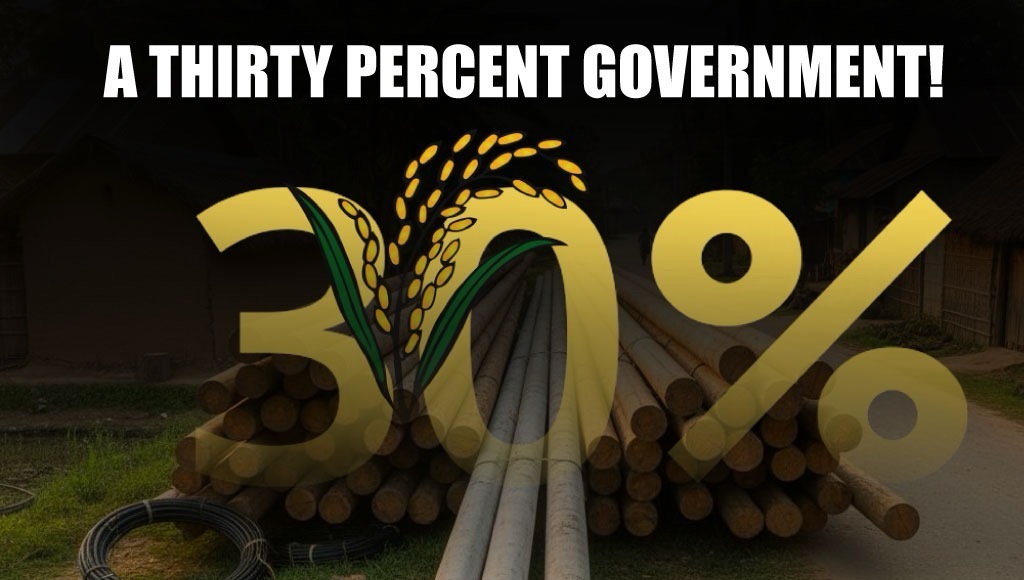
[A Thirty Percent Government!]
For them, this is simply how things work. We are in power, we get our share — that is the logic. This is not a fight against corruption. It is a fight to treat corruption as one’s rightful entitlement. This is the BNP’s idea of “change.”
MP Rokun Uddin Babul answered the phone, said he was outside, and told the caller to speak with Sabuj before hanging up. Impressive sense of responsibility. Thirty percent is being skimmed off in his name, yet he apparently has no time to discuss it. A busy man, after all.
Remember the vote on February 12. No major political parties were really present, a large portion of the public did not vote, and calling what happened an election would be like calling biryani panta bhat. Through that process a government came to power, and within weeks of forming it, relief rice meant for the poor is already being divided in the names of its MPs. The people of Bangladesh have seen this before. From 2001 to 2006, the era of Hawa Bhaban and its “two princes,” the deep politicization of the administration, and extortion even from relief meant for the poor. That chapter seems to be opening again. The only difference is that the characters are a little older now.
Back then the BNP also used to say, “We are fighting for democracy.” They still say the same thing today.
And the result of that struggle is that the rice meant for the poor ends up becoming the gentlemen’s thirty percent.
Shamsuzzaman Sabuj has denied the allegations. Fair enough. But the audio does not deny it. The voice on the other end of the phone does not deny it. The words — “You will hand over 1,003 tokens; Sabuj won’t even need to be recognized” — do not simply disappear into thin air. They remain recorded.
One of the enduring tragedies of politics in Bangladesh is that those who are out of power see themselves as virtuous, but the moment they come to power they forget all about that virtue. For years the BNP has said the country is plagued by corruption and looting, that people have no rights. They have said it so often that their mouths foamed with indignation. Yet once they sat in power, it did not even take long to wipe that foam away. Within weeks of forming the government, they are demanding a share of relief meant for the poor. This is where years of “struggle and movement” have finally arrived.
In truth, the BNP resembles that thief who never changes — neither himself nor the way he steals.