
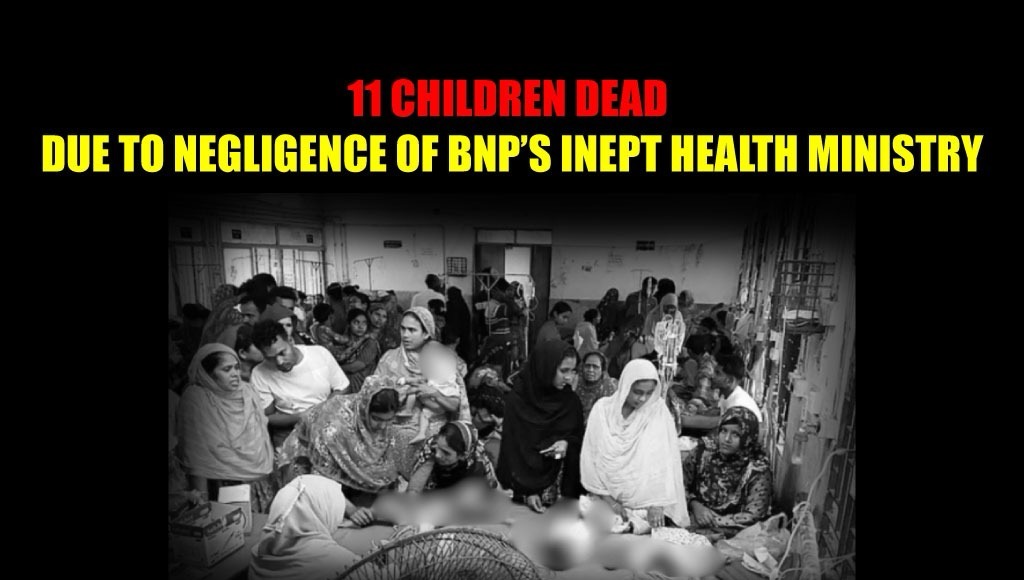

Recently, 11 children died at Rajshahi Medical College Hospital due to a shortage of ICU ventilators. In response, Tareq’s health minister expressed anger, saying the hospital director deserved the death penalty for failing to inform the minister in time about the lack of ventilators.
Now let’s look at this from another angle. During the tenure of the Awami League government, one of the major “Digital Bangladesh” success stories was the Directorate General of Health Services and the ministry’s digital reporting system. At that time, all government hospitals—even community clinics—were required to submit reports online. These reports included detailed data, such as the number of functional and total ventilators in each hospital. Based on this reporting, a national award was introduced in 2017 for health system strengthening scores. All of this data and scoring were maintained online.
Out of curiosity, I checked today and saw that the last update was in July 2025. In that ranking, Rajshahi Medical College Hospital was ranked first in the medical college category. So, according to that ranking, it was the best hospital in the country as of July 2025. At that time, all 20 out of 20 ventilators were operational. If 11 children can die waiting for ventilators in the country’s top-ranked hospital, what must be happening in the others? And who is responsible?
Clearly, responsibility lies with Noorjahan, the health adviser under Yunus, who came to power illegitimately in 2025.
Before assigning blame, let’s look at more data. Apart from the DG Health scoring system, there is another report called the Local Health Bulletin. It’s quite useful—one click generates a statistical report of a hospital, including various metrics. Interestingly, while it includes ICT equipment like laptops and computers, it does not include ventilator data. However, it does document decisions made in monthly hospital management meetings. The latest such discussion at Rajshahi Medical College was held in August 2025. There was no mention of ventilators in that meeting. After that, there have been no further updates or online records.
These meetings are chaired by the local Member of Parliament. In fact, across the country, MPs serve as heads of hospital management committees to ensure they are aware of local healthcare issues and can push the government for solutions. Therefore, if there is a problem in a hospital, responsibility lies not only with the director but equally with the MP. Will the BNP health minister also call for the execution of the local MP? One might argue the government is new and MPs haven’t yet had time to attend such meetings.
[11 Children Dead Due to Negligence of BNP’s Inept Health Ministry]
But more than a month has already passed under the BNP government. Has the MP visited Rajshahi Medical College Hospital? The local MP is BNP’s Mizanur Rahman Minu. Has he been asked whether he was aware of the hospital’s issues or attended any management meetings?
Beyond these meetings, civil surgeons at the district level and divisional offices are supposed to conduct monthly on-site monitoring of subordinate hospitals, using a checklist. When was the last such monitoring at Rajshahi Medical College Hospital?
There is also a separate online system for hospital logistics management, where inventories are reported. These reports are not public. Additionally, under DG Health’s DHIS2 system, all hospitals submit monthly reports, including ventilator data. Officials in the Directorate and the Ministry are supposed to review these. There is even a public dashboard where patient complaints via SMS and their resolutions can be tracked.
A friend of mine who works at a provincial health ministry in Canada once told me that the monitoring systems introduced under Sheikh Hasina’s leadership are more extensive than what exists there. By looking at these systems, people can easily compare the state of healthcare during the Awami League government’s tenure and under the BNP.
So, it’s clear: there is no shortage of systems, no shortage of data, and no shortage of personnel assigned to monitor them. The real question is—how many are actually doing their job? If they are, why are problems not being solved? Where is the breakdown?
Why would the hospital director need to call the minister personally? The minister and their office have access to all this data. Does the director even have constant access to the minister? Did the director formally report the issue through proper channels? Even if not, multiple layers of bureaucrats are assigned to monitor each hospital. They too are responsible for knowing the ground reality.
Sheikh Hasina’s government had already created systems capable of addressing 99% of the country’s healthcare challenges. By failing to utilize these resources, the BNP health minister has demonstrated clear incompetence.
At the same time, it raises a deeper concern: the “smart” healthcare system developed during the Awami League era now appears to be on the verge of collapse.