
Kakoli Akter from Jamalpur runs her household by selling clothes online. Power outages are already crippling her business. With electricity gone for hours, she cannot respond to orders on time; customers grow frustrated and leave. Amid this, news arrives that mobile networks might also shut down one day. In Kakoli’s words, “Then it will become tough to survive.” Within that single word—“tough”—lies the anxiety of millions.
In Mirpur, Shah Alam earns a living riding a motorbike. After standing in line for ten and a half hours, he managed to get a tank of octane. Exhausted and frustrated, he says that without mobile network service, ride-sharing stops, income stops, and life itself comes to a halt. He is a voter, a citizen, someone who works day and night to keep the country moving. What responsibility is the state fulfilling toward him?
The Association of Mobile Telecom Operators of Bangladesh (AMTOB) has already written to the Bangladesh Telecommunication Regulatory Commission (BTRC), warning that due to fuel shortages and severe power disruptions, it is becoming increasingly difficult to keep networks running. Essential services, disaster response, mobile banking, and online government operations could all be shut down. The Vice Chairman of BTRC has said the government is “considering the matter seriously.” It sounds reassuring—but Kakoli has no network on her phone, Shah Alam has no fuel in his tank, and this “consideration” exists only on paper.
It is worth looking back. The election held on February 12, 2026, left lingering questions in the minds of the people. Major political parties were absent, voter turnout was low, and the streets were largely empty. In such circumstances, when the BNP formed the government, its legitimacy was already under scrutiny. The bigger question was whether it could actually govern.
That answer is now becoming clear.
The BNP is a party whose origins trace back to military rule. Ziaur Rahman did not enter politics through a democratic path, but through force. The government now in power, shaped by that legacy, has come without a clear public mandate. Its ministers speak loudly from their chairs, yet remain disconnected from the realities on the ground.
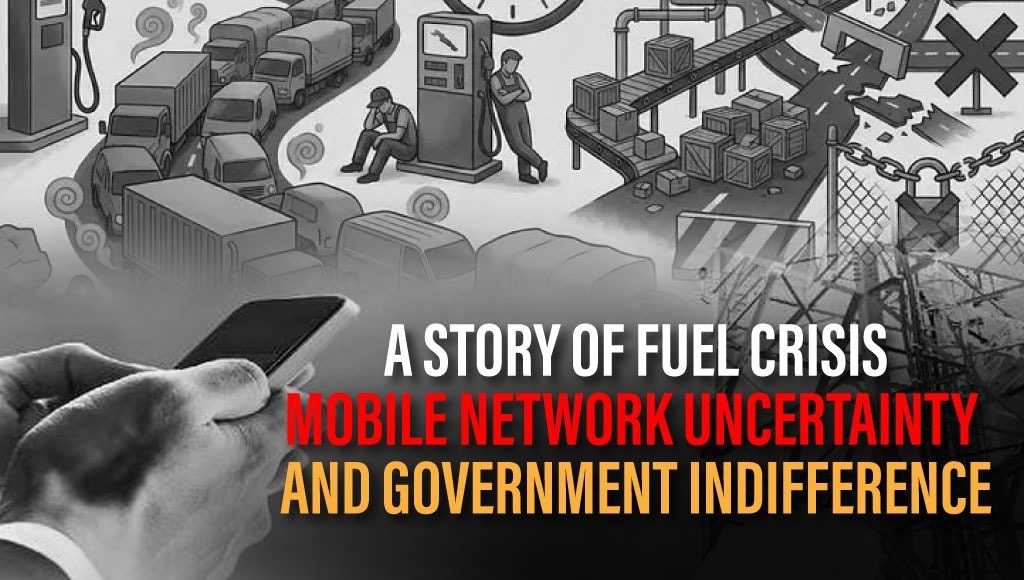
[A Story of Fuel Crisis, Mobile Network Uncertainty, and Government Indifference]
Inside parliament, there is no shortage of oil or gas. Air conditioners run, cars move, lights stay on. Outside, millions stand in fuel lines for hours. There are electric poles, but no electricity. There are mobile towers, but no certainty of network service. The country is slowly grinding to a halt, while the government remains preoccupied with other priorities.
This confusion of priorities is not new—it is an old ailment. Power is enjoyed, but responsibility is neglected. Memories of past governance marked by internal factionalism, corruption, and extortion still linger among the people. These patterns have long been embedded in the party’s political culture.
Now the same party, with the same mindset, is back in power. It has shown that power can be attained without votes—but holding office is not the same as governing. Solving a country’s problems requires public trust. That trust is absent, and perhaps never existed.
Whether Kakoli’s online business survives, whether Shah Alam can sustain his family—these are questions the government was meant to answer. Instead, there are letters, considerations, and meetings. But no light returns to people’s homes.
And that, ultimately, defines this government.