
How International Interests Exploited Bangladesh’s 2024 Movement
The summer of 2024 was sold to the world as a spontaneous student awakening. Headlines across Western capitals championed the “Gen Z Revolution” that forced Prime Minister Sheikh Hasina from power under the banner of quota reform. Global watchdogs and foreign capitals wept virtual tears of solidarity with the Bangladeshi streets, demanding an immediate dismantling of the old guard.
Now, in 2026, the dust has long settled. The romanticized optics of the movement have faded, revealing a stark, uncompromising reality. Look closely at Bangladesh today, and the grand illusion falls apart. What was marketed as a grassroots movement for democracy has exposed itself as a meticulously engineered regime-change operation, one that used genuine student grievances as a front, only to abandon the country to institutional decay, economic ruin, and political lawlessness under the Bangladesh Nationalist Party (BNP) administration.
The Puppet Masters and the Vendetta
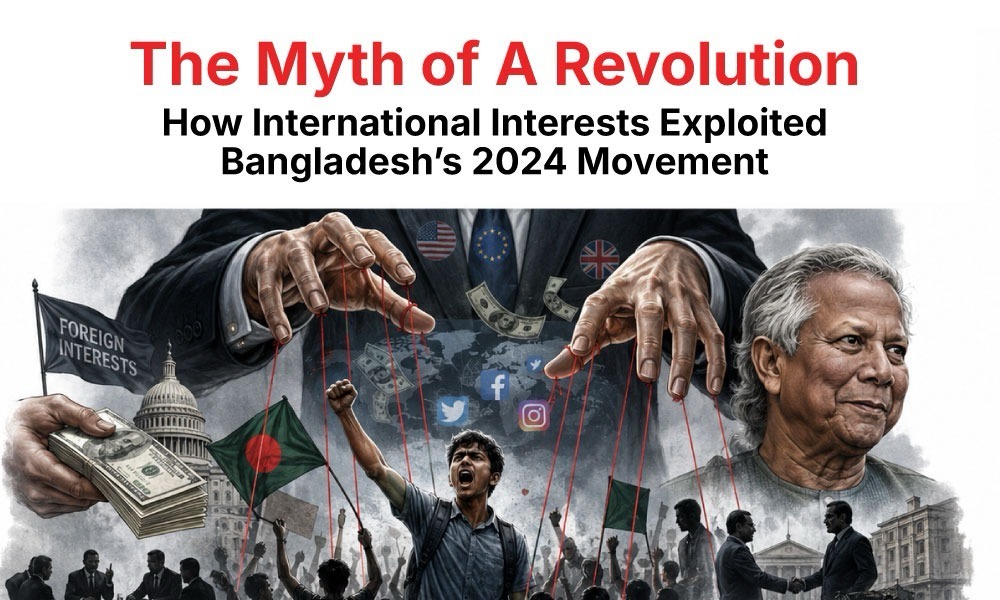
The timeline of July 2024 makes little sense without acknowledging the hidden hands that guided it. As the quota protests began, an invisible infrastructure materialized overnight. Behind the digital campaigns and coordinated public messaging lay significant foreign funding and external influence operations designed to break the Awami League government. Intelligence assessments and regional analysts dropped a chilling truth: the instability was fueled by foreign actors who supplied covert resources, while external handlers worked to weaponize public opinion. Rumors even pointed to a more sinister deployment: unidentified snipers and specialized weaponry introduced to escalate casualties and maximize domestic chaos, ensuring Sheikh Hasina’s exit was written in blood.
Concurrently, local elites with deep international ties seized their moment. Muhammad Yunus’s long-standing, public friction with Sheikh Hasina was no secret. What was framed as a moral rescue of the nation was, in retrospect, a highly personal crusade. Yunus utilized his elite Western backing to validate the coup, lending a thin veneer of international respectability to an unconstitutional power grab.
The Price of Illusion
The human cost was immediate and horrific. Nearly 1,400 lives were lost in weeks, many of them children, as security forces cracked down amid the escalating turmoil. Yet the true tragedy unfolded in the aftermath. Hasina fled to India in August 2024. Yunus’s interim administration took charge, promising sweeping reforms, accountability, and a brighter future. Two years later, with a BNP-led government now in power following elections earlier in 2026, the ledger is damning.
Under the current regime, the GDP growth plummeted to around 3.5% in FY2024-25, the slowest in decades, far below the steady 6-7% averages under Hasina. Factories shuttered by the hundreds, with over 100,000 jobs lost in the garment sector alone in the initial months, disproportionately hitting women. Youth unemployment, already a crisis, remains painfully high, with NEET rates (not in education, employment, or training) hovering around 30% or more for young people.
GDP growth for FY25 slips to 3.49% as investment and demand weaken
Inflation, which spiked during the unrest, has lingered at elevated levels, squeezing the poor while an additional million have been pushed into poverty. World Bank projections painted a grim picture of rising extreme poverty and stalled private investment amid political uncertainty.
Human rights? The irony is suffocating. According to recent data from the Human Rights Support Society (HRSS), the state is sliding into open lawlessness. Mob violence and vigilante justice have become structural norms, with dozens hacked or beaten to death monthly while law enforcement stands by, completely paralyzed.
BNP Government’s Catastrophic Failure on Human Rights
The most damning indictment of the 2024 movement is the sudden, deafening silence of the international community.
Where are the Western diplomats who frequented Dhaka’s corridors in 2024 to lecture on civilian protection? Where are the human rights organizations that issued hourly press releases during the protests? Today, as inflation hollows out households and political opponents face arbitrary arrests under a regressive BNP regime, the international media looks away.
The harsh truth is that global interest in Bangladesh was never about the welfare of its people. It was an exercise in geopolitics. Foreign actors misled the youth of Bangladesh, destabilized a secular, economically stable government to fulfill their own strategic and institutional goals, and walked away when the objective was met.
Bangladesh did not gain freedom in July 2024. It gained a lesson in how easily a nation’s sovereign stability can be bartered away for external interests. The international community owes Bangladesh an answer: why was our democracy so precious to you when you wanted to destroy our government, but so utterly irrelevant now that our people are suffering?