
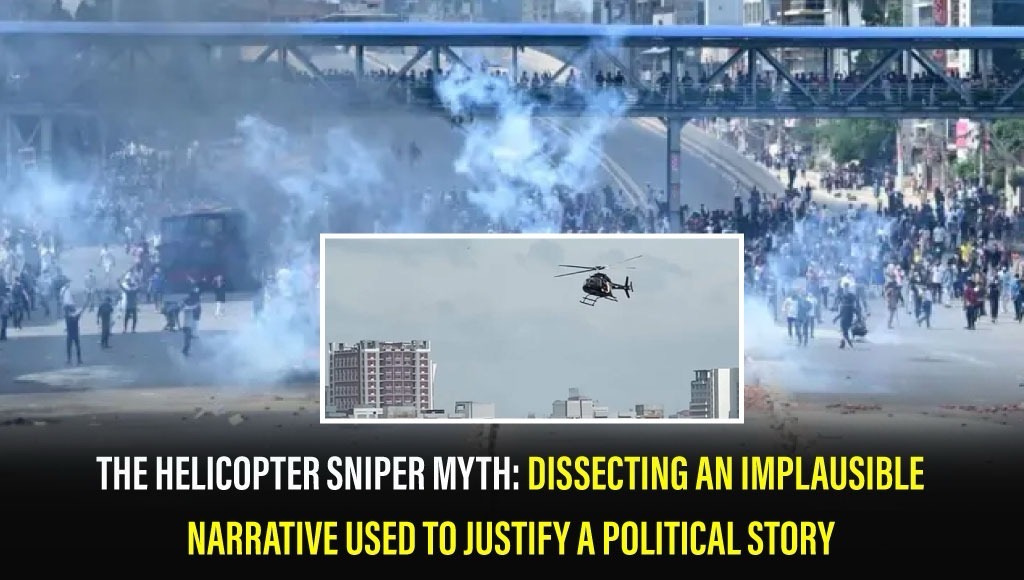

The events of July have produced countless competing narratives. Among the most sensational is the allegation that security forces systematically used helicopter-mounted snipers to shoot civilians from the air. It is a claim that has been repeated so frequently that many now accept it as fact. Yet extraordinary claims require extraordinary evidence. When examined through the lenses of military capability, ballistics, forensic science, and publicly available evidence, the story begins to unravel.
The first question is straightforward: does Bangladesh possess the operational capability to conduct precision sniper fire from a moving helicopter?
Based on publicly available information, the answer appears to be no.
Neither Bangladesh’s military nor its law enforcement agencies have any publicly documented or officially acknowledged training program dedicated to aerial precision sniper operations. Such capabilities are exceptionally rare even among the world’s most advanced security forces. Elite units, including the FBI’s Hostage Rescue Team and a handful of military special operations commands, spend years developing these skills through intensive training, sophisticated equipment, and substantial financial investment.
No comparable evidence exists to suggest that any Bangladeshi force has acquired or demonstrated this highly specialized capability. Yet despite this absence of evidence, the helicopter sniper narrative has been promoted as though it were an established historical fact.
The technical realities make the allegation even more difficult to sustain.
There are essentially two ways helicopters are used to deliver firepower. The first is suppressive area fire using door-mounted machine guns such as the M240 or M60. These weapons are designed to saturate an area rather than eliminate individual targets with precision.
Had such weapons been used over crowded streets, investigators would reasonably expect to find widespread ballistic damage: numerous victims struck by randomly dispersed rounds, extensive bullet impacts on roads, buildings, vehicles, and surrounding structures, and a large volume of recoverable ballistic evidence.
No publicly available forensic record from the July incidents has demonstrated that pattern.
The second possibility is precision sniper fire from a moving helicopter. This presents an even greater technical challenge.
A sniper operating from an aircraft must compensate simultaneously for rotor wash, continuous vibration, aircraft speed, changing altitude, target movement, wind conditions, and ballistic trajectory, all within fractions of a second. This requires advanced techniques, including sophisticated lead calculations mastered by only a small number of elite military units worldwide.
There is no publicly available evidence that Bangladeshi forces possess this capability. Had they successfully conducted such operations, it would represent an extraordinary level of operational proficiency. Yet no corresponding forensic evidence has emerged to support such an extraordinary conclusion.
The forensic questions are equally important.
Bullets fired from an elevated helicopter would ordinarily strike victims from above, producing characteristic downward wound trajectories that forensic pathologists can identify during postmortem examinations. Entry and exit angles often provide crucial information about the shooter’s relative position.
If helicopter sniper attacks had occurred as alleged, one would expect those ballistic characteristics to appear consistently in independent medical or forensic reports and to be presented before international experts.
To date, no publicly available independent forensic report has documented such evidence. On the contrary, some reported wound characteristics have been described as being consistent with shots fired from ground level.
Another often overlooked fact is that the Rapid Action Battalion (RAB) publicly acknowledged deploying helicopters to disperse sound grenades and tear gas during the unrest.
The loud explosions, smoke trails, and confusion created by these devices could easily have been interpreted by frightened witnesses as aerial gunfire. Cognitive psychology has long demonstrated that during moments of extreme stress and panic, eyewitnesses can sincerely misinterpret what they hear and see. Such perceptual distortions are well documented and should not be ignored when evaluating testimony from chaotic events.
Ultimately, allegations of this magnitude cannot rest on repetition alone.
In any credible investigation, claims involving helicopter snipers would require verifiable supporting evidence: authenticated video footage, forensic reports, ballistic analyses, radar data, aircraft mission records, or findings from independent investigative bodies.
Despite the seriousness of the allegation, no publicly verifiable body of evidence meeting these standards has been presented through independent investigations or internationally recognized forensic documentation.
This does not automatically prove that every allegation is false. It does, however, mean that the claim remains unverified. And until compelling evidence is produced, the helicopter sniper narrative should be treated not as established historical fact, but as an allegation that has yet to withstand rigorous technical and forensic scrutiny.
Public memory deserves more than dramatic stories. It deserves evidence. History should ultimately be written not by slogans or speculation, but by facts that can withstand independent examination.