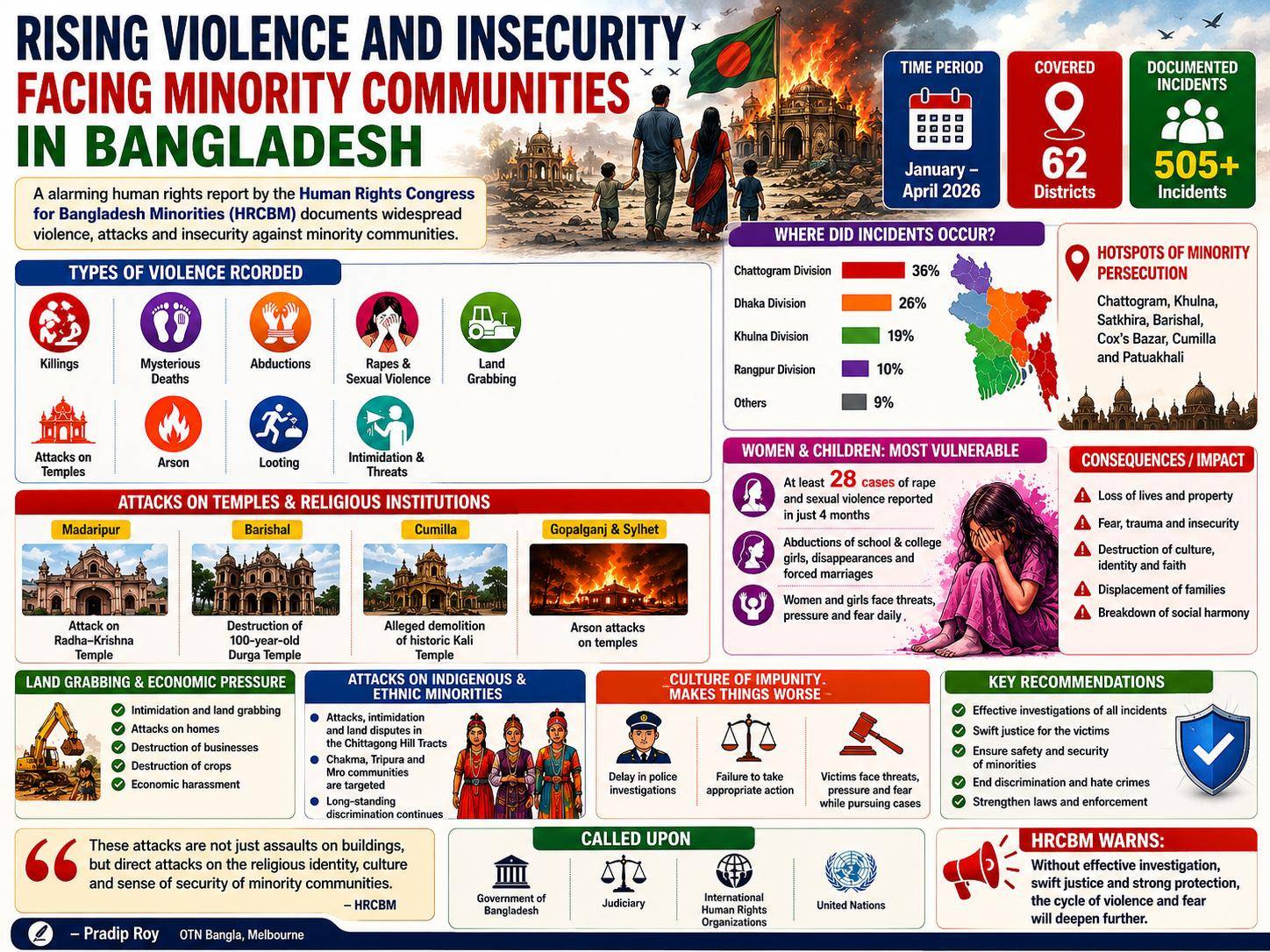

A deeply concerning human rights report has been published regarding violence, attacks, and insecurity faced by minority communities in Bangladesh. According to the report by Human Rights Congress for Bangladesh Minorities (HRCBM), at least 505 incidents of violence were documented across 62 districts of the country within just four months, from January to April 2026. These incidents include allegations of murder, mysterious deaths, abduction, rape, land grabbing, attacks on temples, arson, looting, and intimidation.
According to the report, the highest number of incidents occurred in the Chattogram division, followed by Dhaka, Khulna, and Rangpur divisions. Chattogram, Khulna, Satkhira, Barishal, Cox’s Bazar, Cumilla, and Patuakhali were identified as major hotspots of minority persecution. A significant portion of the report details attacks on temples and religious institutions, including an attack on the Radha-Krishna Temple in Madaripur, the destruction of a century-old Durga Temple in Barishal, allegations of demolishing a historic Kali Temple in Cumilla, and incidents of arson targeting temples in Gopalganj and Sylhet.
The organization stated that these attacks are not merely assaults on physical structures, but direct attacks on the religious identity, culture, and sense of security of minority communities. The report also highlights land grabbing and economic pressure as major concerns. It documents allegations from various regions where minority families were intimidated, their land seized, homes attacked, businesses destroyed, and crops damaged.
The report identifies women and children as among the most vulnerable groups. At least 28 incidents of rape and sexual violence were documented during the four-month period. Allegations also include the abduction, disappearance, and forced marriage of school- and college-going girls. The report further highlights violence against Indigenous and ethnic minority communities, particularly in the Chittagong Hill Tracts region, where members of the Chakma, Tripura, and Mro communities reportedly faced attacks, intimidation, and land-related disputes.
[Rising Violence and Insecurity Facing Minority Communities in Bangladesh]
HRCBM stated that delays in police investigations, failure to take appropriate action, and a culture of impunity have further complicated the situation. Many victims, according to the report, have faced intimidation and pressure that discouraged them from pursuing legal action. The report concludes that violence against minorities in Bangladesh is not a series of isolated incidents, but rather a manifestation of long-standing structural discrimination, insecurity, and weak institutional protection.
In response, HRCBM has called on the Bangladesh government, judiciary, international human rights organizations, and the United Nations to take effective action. The organization warned that without proper investigations, swift justice, and stronger protection for minority communities, the cycle of violence and intimidation could deepen further.
— Pradip Roy, OTN Bangla, Melbourne.