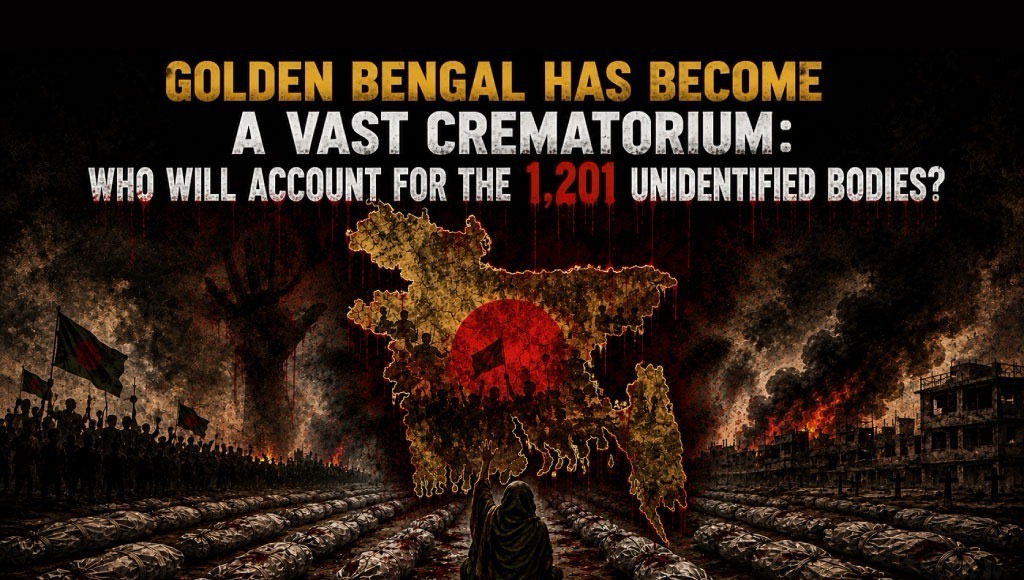

According to the Human Rights Culture Foundation, between 5 August 2024 and 30 June 2026, a total of 1,201 unidentified bodies were recovered from the country’s rivers, canals, roadsides, fields, and other locations. These were people with no names, no known identities, and no families who came forward to claim them. Among them were 786 men, 290 women, 58 children, while the condition of 25 bodies was so severely decomposed that even their age and sex could not be determined.
These are not merely statistics on paper. Each number represents a mother still waiting, a child whose father never returned home, or a wife who continued serving meals in the hope that her husband would walk through the door again.
Those in power today, despite their lofty rhetoric, are unlikely to answer for these deaths. According to this perspective, these bodies are the outcome of a political project whose successors now occupy the seats of power. No matter how much the events of July 2024 are portrayed as a glorious chapter in history, the argument presented here is that they were a planned campaign of violence, allegedly supported by foreign funding, operational assistance from Islamist militant groups, and the silent backing of the military. An elected government was overthrown through street unrest, and Muhammad Yunus, described here as a microfinance lender who built his career by charging interest to the poor, was elevated as the country’s savior. Although tanks never rolled into the streets, the author argues that, in terms of its outcome, it amounted to an unlawful seizure of power.
The bloodshed that began during Yunus’s eighteen-month administration, the article claims, never ceased. Police cases multiplied across the country, arbitrary detentions continued, enforced disappearances allegedly took place under the cover of darkness, and unidentified bodies increasingly appeared on riverbanks, in fields, and by the roadside. According to the cited figures, 213 unidentified bodies were recovered in 2024, the number rose to 641 in 2025, and 347 more were found in just the first six months of 2026. These increasing numbers, the author argues, indicate that conditions have deteriorated rather than improved.
The article further argues that the BNP-Jamaat government, which assumed office on 17 February, represents a continuation of the same political trajectory. Regardless of what the election results may show, the government is described as resting upon the same foundation laid by the violence of July. The author contends that a political alliance that had long worked alongside Jamaat cannot suddenly become a champion of justice after assuming power. Questions are no longer asked with the same intensity, the article claims, because many of those who might have raised them are now among the 1,201 unidentified dead, while others have fled the country.
There was a time when this nation was proudly known as Sonar Bangla (Golden Bengal). The name echoed through Rabindranath Tagore’s songs, Bangabandhu Sheikh Mujibur Rahman’s speeches, and the blood-soaked soil of the Liberation War. Today, the author concludes, the country has become a vast crematorium where new bodies appear every day, yet no one keeps count, no one demands justice, because those who seek accountability fear that the next unidentified body may be their own.