
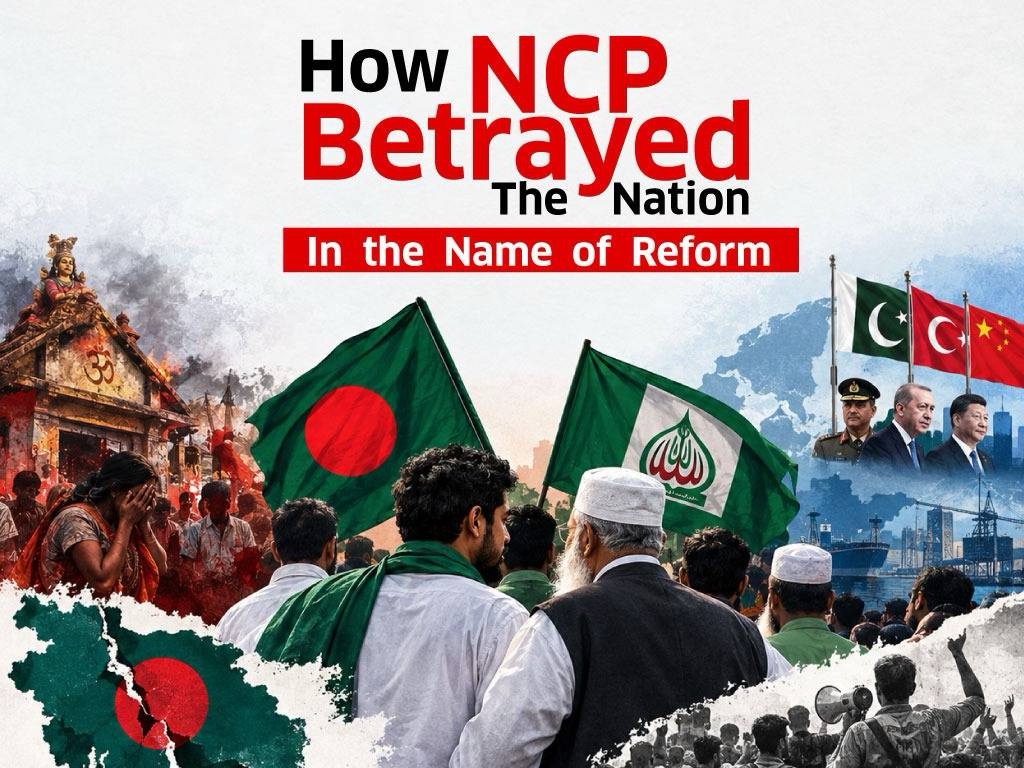

By allying with radical elements and shifting toward a pro-Pakistan geopolitical axis, Bangladesh’s student-led party is abandoning the very pluralism it swore to protect.
Remember the slogan from the 2024 student uprising: “Who are you? Who am I? Razakar, Razakar!” At the time, it was used by protesters to express anger, challenge the political order, and demand fairness, reform, and a better future.
Two years later, it carries an uncomfortable irony.
The National Citizen Party (NCP), formed by a few student leaders from the July uprising, stands accused of becoming the very thing it once named and shamed. From questioning the moral weight of 1971 to sharing political platforms with Jamaat-e-Islami, the NCP’s trajectory has raised serious questions about what happened to the ideals of the “July spirit.”
Bangladesh Jamaat-e-Islami Draws NCP and LDP Into an Islamist Alliance
For critics, the contradiction is difficult to ignore: a movement that promised to create a new political path now finds some of its leading figures working alongside a party associated with the forces that opposed Bangladesh’s independence. It raises a blunt question for any serious observer of South Asian politics: has the “July spirit” evolved into something increasingly sympathetic to anti-independence politics and, at least in some respects, Pakistan’s historical narrative?
What Was Promised Vs. What Happened
The NCP emerged from the student-led events of July–August 2024. Its founders, led by Nahid Islam, promised a clean break from established political forces. They sold themselves as the authentic voice of a new Bangladesh: reformist in ambition and unburdened by the sectarian baggage of the past.
NCP’s coalition with Jamaat puts party identity under sharp scrutiny
That claim collapsed in December 2025. Jamaat-e-Islami Ameer Shafiqur Rahman announced that the NCP had formally joined Jamaat’s electoral alliance. The party that once brandished the Razakar label now sought seats under the umbrella of the organization most closely identified with opposing Bangladesh’s independence and collaborating with Pakistani forces in 1971. NCP leaders insisted the arrangement was “strategic, not ideological.” The internal body count told a different story: by the party’s first anniversary in February 2026, at least 60 leaders and activists had resigned. Senior figures warned that the deal would make the NCP “pay a heavy price.” More than a dozen central leaders walked out within days of the announcement, citing betrayal of the values they had claimed to represent.
Inside Bangladesh’s Emerging Islamist-Led Coalition
The alliance delivered six parliamentary seats for the NCP out of the 30 it contested. Jamaat’s broader coalition took 77. Nahid Islam became opposition chief whip. The promised “new politics” had become junior partner to the oldest Islamist force in the country.
The Long March Made The Contradiction Visible
The alliance is no longer just an electoral arrangement. It is now visible on the streets.
In September 2026, NCP Convener Nahid Islam appeared alongside Jamaat-e-Islami Ameer Shafiqur Rahman at rallies and long-march programmes organised by the Jamaat-led 11-party alliance. At the Dhaka-Chattogram long march, both addressed the inaugural rally, while Nahid also spoke at roadside rallies along the route.
NCP Leaders at Jamaat Long March
That matters because the NCP was born from a movement that presented itself as a break from Bangladesh’s established political order. Today, some of its leading figures are standing shoulder-to-shoulder with Jamaat’s political machinery.
The NCP maintains that its relationship with Jamaat is strategic, not ideological. That distinction is important. But political alliances are also judged by actions: who parties campaign with, share platforms with, and repeatedly choose as political partners.
When a party born from a movement promising a new political culture repeatedly appears on platforms organised by another party, a straightforward question follows:
Where, exactly, is the political boundary between them?
Minority Safety Makes That Question More Urgent
While the NCP perfected its new alliances, religious minorities paid a measurable price.
The Bangladesh Hindu Buddhist Christian Unity Council documented 257 incidents of communal violence during January–June 2026, including 44 deaths, 62 attacks on temples and other places of worship, and 47 attacks, arson incidents, or acts of vandalism involving homes and businesses.
Independent tallies cited by regional and international outlets placed the number of minority deaths in the dozens to over a hundred in successive reporting periods. High-profile cases, the December 2025 lynching of garment worker Dipu Chandra Das over alleged blasphemy, the murders of community leaders, and repeated assaults on temples, became grim markers of the period.
The lived reality for minority communities, and the scale of the numbers recorded by their own organizations, suggested a climate in which hardline networks operated with greater freedom. The NCP’s decision to bind itself to Jamaat did nothing to reassure those communities. It sent the opposite signal.
Pakistan, China And Türkiye: A Changing Strategic Environment
The NCP-Jamaat partnership is also unfolding in a changing regional environment.
Bangladesh’s relations with Pakistan have visibly warmed, while ties with China and Türkiye have expanded. In August 2025, Pakistan’s deputy prime minister and foreign minister met representatives of NCP and Jamaat, among other Bangladeshi political actors.
Pak deputy PM meet NCP, Jamaat, BNP leaders
More recently, Bangladesh said it would consider joining the Mecca defence pact involving Pakistan, Türkiye and Saudi Arabia if invited. Reuters reported that analysts viewed such a move as potentially challenging Bangladesh’s long-standing non-alignment and complicating its relationships with India, China, the United States and others.
Five reasons why Bangladesh shouldn’t join the Mecca Pact
Türkiye has stepped up both defence and political engagement with Dhaka, including high-level military visits. China’s involvement has expanded beyond infrastructure projects into wider strategic cooperation. Defence contacts between Bangladesh’s army leadership and Turkish counterparts, parallel meetings with Pakistani officials, and Chinese diplomatic outreach to Jamaat leaders all point in the same direction.
Dhaka, Ankara seek closer defence ties
Regional media have also reported claims of external encouragement for political agitation, including alleged training and logistical support. Not every detail has been independently confirmed. What is clear, however, is the pattern: the same political forces that now host NCP leaders on long marches maintain open relationships with countries that historically opposed or sought to weaken Bangladesh’s independence.
The Question NCP Cannot Avoid
The students of 2024 were right about one thing: the word “Razakar” still carries moral force. What they did not anticipate is that their own political vehicle would supply the evidence for its return. An alliance with Jamaat, the presence of NCP leaders on Jamaat’s long marches, the abandonment of the inclusive promise they once claimed, the failure to protect minorities, and the quiet alignment with external actors hostile to Bangladesh’s founding story form a coherent picture. The NCP did not merely make a tactical error. It chose a political family whose historical project was the negation of the very independence the 1971 generation died to secure.
International observers watching Bangladesh’s recent transition should not be distracted by the residual romance of the student movement.
The romance is over.
What remains is a party that traded the moral clarity of 2024 for the organizational muscle of Jamaat, and in doing so handed its critics the simplest possible indictment: the slogan they once shouted has begun to describe them.