
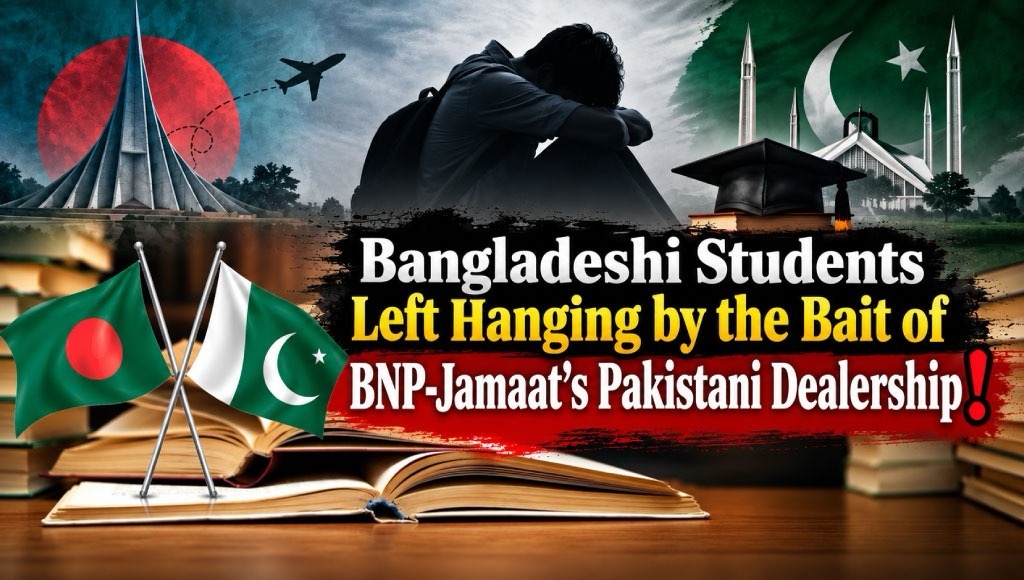

Last August, when Pakistan’s Deputy Prime Minister Ishaq Dar arrived in Dhaka, his visit generated considerable excitement across diplomatic circles. It was the first visit to Dhaka by a Pakistani foreign minister in nearly 13 years, accompanied by grand rhetoric, talk of a new friendship, and a glossy announcement—the “Knowledge Corridor.” The initiative promised 500 fully funded scholarships over five years, covering everything from tuition and food to accommodation, stipends, and airfare—a dream package for aspiring students. The government and alliance that were so eager to renew ties with Pakistan sought to portray the moment as something of a diplomatic victory.
A year later, where has that victory narrative ended up?
A group of young people who spent months sitting for examinations, going through the selection process, and making one of the biggest decisions of their lives based on these promises have now received offer letters that mention only tuition fees and hostel expenses. There is no food allowance, no monthly stipend, no travel support, and no airfare. The very things essential for a student to survive abroad have simply disappeared.
The question now is: What role did Dhaka play in this entire process?
The same government that enthusiastically promoted the strengthening of ties with Pakistan and was itself involved in publicizing the scholarship initiative became completely silent when students alleged that they had been misled. When Nazrul Islam, the bilateral secretary at the Ministry of Foreign Affairs, was asked about the matter, his response was that the issue was apparently not in their “knowledge.” A scandal involving the futures of hundreds of students, about which complaints have reportedly been submitted for months, had apparently escaped the attention of the Ministry of Foreign Affairs. Whether this is ignorance or deliberate avoidance is a legitimate question to ask.
The situation at Pakistan’s High Commission in Dhaka appears to be much the same. Counsellor Shabid Ullah Wazir repeatedly said that they were trying to collect information, yet even by mid-September, there was no satisfactory response. Emails sent to Pakistan’s Higher Education Commission also reportedly went unanswered for two weeks. In other words, the institutions responsible for keeping this bilateral relationship credible appear to have passed responsibility from one to another rather than addressing the problem.
That is the real issue.
It is easy to create grand symbolic moments in foreign policy—to arrange a visit, make an announcement, take photographs, and collect applause. But when it comes to implementing those promises and gaps begin appearing at every stage, the government that was so vocal about the relationship should be the one facing the greatest degree of accountability.
Instead, what we are seeing is a form of institutional silence, while the victims are ordinary young men and women whose families may already have spent money arranging visas, medical examinations, and other initial expenses.
Former ambassador Munshi Faiz Ahmed has described the incident as tantamount to fraud, saying he believes such a situation would not have occurred in another country. Former foreign secretary Shahidul Haque has also said that there is a gap somewhere in the process and that it is the responsibility of the Ministry of Foreign Affairs to identify it. The comments of these diplomatically experienced figures make one thing clear: this is not merely a paperwork error; it is a crisis of accountability.
Ultimately, the questions remain.
When the first real test of a relationship that was renewed with so much fanfare ends up putting the futures of hundreds of students in jeopardy, how strong was the foundation of that relationship in the first place?
And those who spoke so loudly about this renewed relationship—why are they so silent now?