
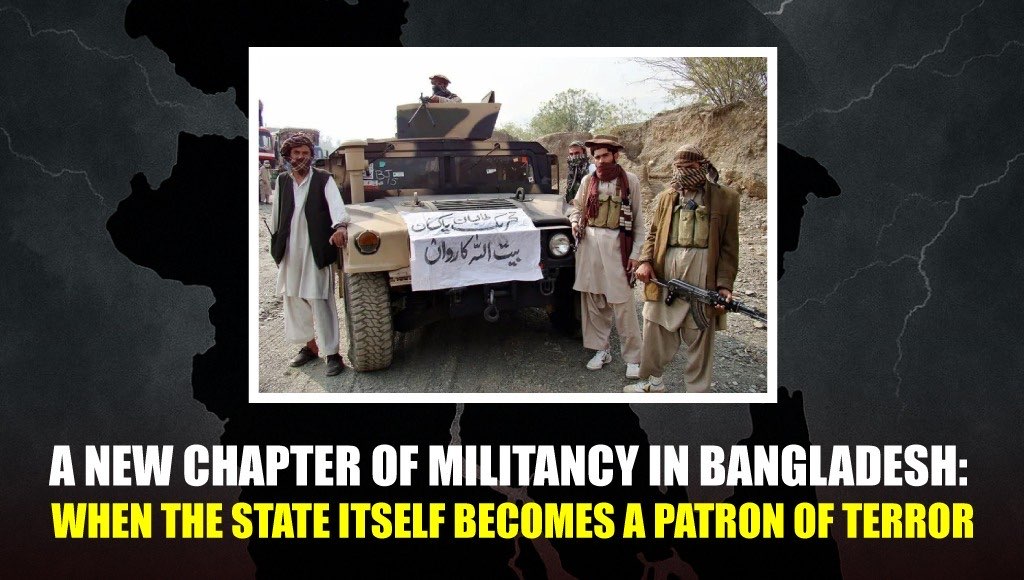

The successive reports of Bangladeshi youths being killed or arrested while fighting for Tehrik-i-Taliban Pakistan on Pakistani soil are, in reality, only small glimpses of a much larger truth. The truly frightening issue is that the very state whose territory once hosted these militant networks for years is now itself under the control of a group that believes in the same ideology. This is not a conspiracy theory. It is the grim reality reflected in police records and recent developments.
What happened in July 2024 can be framed as a student movement as much as one likes, but the real forces behind the events are no longer hidden. It was a carefully planned riot aimed at toppling an elected government, involving foreign funding, active participation by Islamist militant groups, and the silent backing of sections of the security forces. The result was Muhammad Yunus assuming power, backed by Jamaat-e-Islami and ideologically aligned jihadist groups. Once celebrated as a Nobel Prize–winning economist, he has now become the face of a coup government whose illegitimacy is treated as unquestionable.
The details revealed in police case documents are chilling. An individual named Engineer Imran Haider spent years recruiting manpower from Bangladesh for the TTP. There were open incidents of hanging banners in front of Baitul Mukarram Mosque to recruit “mujahideen.” Groups like Jamaatul Ansar Fil Hindal Sharqiya, which have direct links to al-Qaeda, operated freely. Did all this happen overnight? No. It was possible because a political environment was deliberately created in which ideological supporters of militancy were able to consolidate their strength.
There is little left to say separately about Jamaat-e-Islami’s role. Its history is well known. It is an organization of war criminals who participated in the genocide of 1971 and never truly accepted Bangladesh’s independence. They dream of an Islamic caliphate where modern democratic values have no place. After the events of July, they now have a golden opportunity to turn that dream into reality. Their people are being placed across different levels of the administration, their influence in the education system is growing, and organizations that once operated underground are now functioning almost openly.
What is striking is that the military, under the cover of so-called neutrality through which this entire coup was carried out, knew very well who was behind it. Pakistan’s intelligence agencies had been sharing information with relevant Bangladeshi authorities about TTP networks. Yet instead of acting on that intelligence, what happened? When riots spread across the country in July and conspiracies to overthrow the government were underway, sections of the security forces remained silent spectators. Some even actively cooperated.
Today, questioning the legitimacy of the government in power is treated as an act of treason. Muhammad Yunus, who spent years building a business model that pushed the poor deeper into poverty through microcredit, is now the chief adviser of the state. Behind him stand Jamaat-e-Islami and its allied organizations. A country that once took tough measures to curb militancy now finds the patrons of militancy controlling the machinery of the state. What could be more dangerous than this?
The stories of Bangladeshi youths joining the TTP reveal how systematically this network operates. Travel to Saudi Arabia under the pretext of performing Umrah, then onward to Pakistan and Afghanistan. Initial training is provided inside Bangladesh, after which selected individuals are sent to Pakistan. This entire process continued for years. Some of those involved were even arrested earlier, only to be released and return to the same activities.
The question now is: what lies ahead for Bangladesh? How safe can ordinary people be in a country where ideological supporters of militancy have captured state power? With Jamaat and similar organizations, hiding behind nominal political parties and predatory moneylenders, now holding real power, it is only natural that they will give militant networks even greater freedom to strengthen themselves. And the military, which played a facilitating role in this entire process, has no credible reason to suddenly become proactive in suppressing militancy.
Foreign funding cannot be ignored either. External involvement in political upheavals is nothing new. But when such funding flows through organizations linked to militancy, the danger multiplies. Where did the money used to fuel the July riots come from? Who supplied it? And why was such a change desired, one that placed organizations like Jamaat at the center of power?
Bangladesh now faces a situation where the state apparatus itself has become a shelter for militancy. A police force that once pursued extremists now takes orders from a government backed by the very patrons of extremism. The influence of this ideology is steadily penetrating the judiciary, the administration, education, and every other sector. The most alarming part is how openly this process is unfolding. Those who should speak out are either silent or being silenced.
The deaths of two Bangladeshi youths on Pakistani soil are merely a small sample of a much larger crisis. The real problem is that under the current political conditions, such incidents will increase, not decrease. As long as organizations like Jamaat remain at the center of power, militancy will continue to expand. And the illegitimate government now in office has no intention of stopping it. On the contrary, it benefits from it.
Do the people of this country realize who now holds state power? Usurious elites and the patrons of militancy. A nation once rooted in the spirit of the Liberation War now finds itself ruled by organizations of war criminals and their allies. What greater tragedy could there be?