
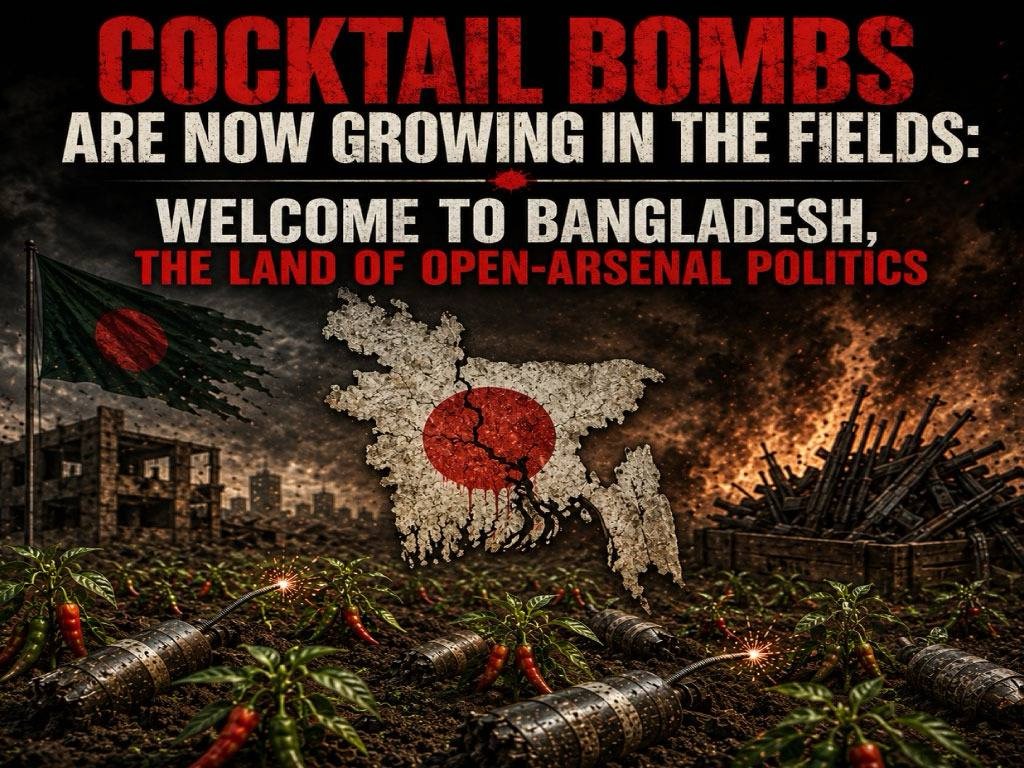

A cocktail bomb was found in a chilli field in Shariatpur. Ten-year-old Rahat picked it up, mistaking it for a ball. It exploded in his hands, blowing off both of his wrists. He is now being treated at Dhaka Medical College Hospital.
That single incident says a great deal about the state Bangladesh has reached today.
But one thing needs to be stated clearly. Shariatpur is not defined by this incident alone. Just two months earlier, in March 2026, supporters of Jamaat reportedly attacked around 40 homes belonging to BNP supporters in Naria upazila of the same district. Hundreds of crude bombs were allegedly detonated, and widespread vandalism and looting took place. This happened after the election. It happened after the formation of the government. In the same district, during the same period. If cocktail bombs are lying in agricultural fields, they did not fall from the sky.
[Cocktail Bombs Are Now Growing in the Fields: Welcome to Bangladesh, the Land of Open-Arsenal Politics]
The relationship between BNP-Jamaat politics and explosives is not a new one. After coming to power in 2001, the country witnessed bomb attacks on cinemas, shrines, universities, and the nationwide serial bombings that shook Bangladesh. The planning behind the August 21 grenade attack was also found by investigators and the courts to have involved individuals linked to Hawa Bhaban, Jamaat leaders, and Islamist militants. This is not merely an allegation; it is part of the judicial record and official investigations.
The government now says the matter is under investigation. Let the investigation continue. But when a political culture with a long history of using explosives as a tool of violence remains in power, and cocktail bombs are found abandoned in chilli fields while a child loses both hands, there is little room to dismiss it as a coincidence.