
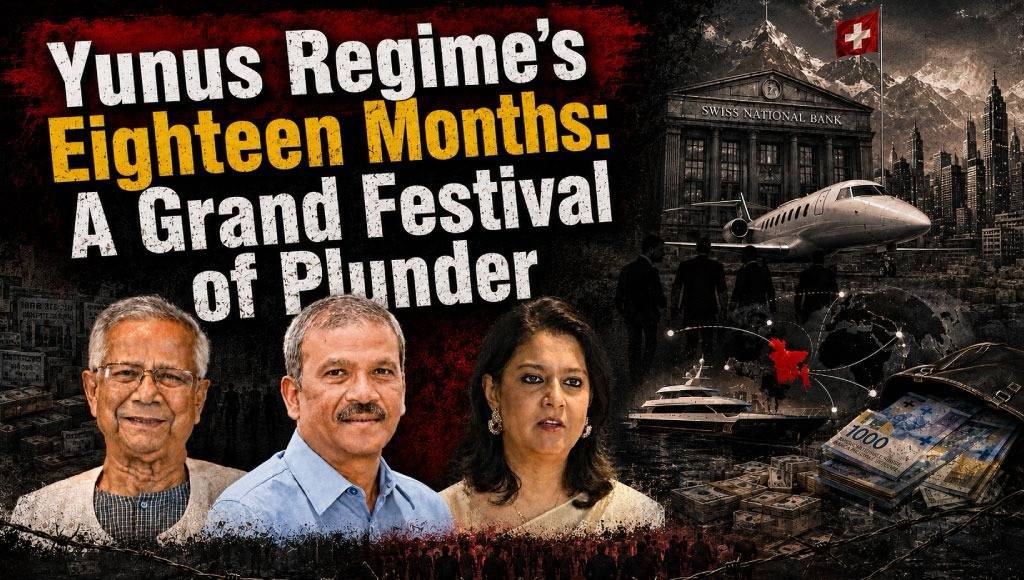

The eighteen-month rule of the former government led by Dr. Muhammad Yunus has secured a place in history as a nightmare chapter for Bangladesh. The contrast between the Nobel Peace Prize laureate’s image as a savior and his government’s alleged record of corruption and looting presents a striking paradox. As time passes, the stench of corruption embedded in every layer of that administration has become increasingly difficult to ignore. Beyond administrative failures, the Yunus government is accused of presiding over a vast empire of economic wrongdoing that, according to critics, surpassed previous scandals in scale and impact.
A recently published annual report by the Swiss National Bank sheds light on this issue. The report reveals a startling statistic: within just one year, deposits held by Bangladeshis in Swiss banks increased by nearly 41 percent, reaching 834.1 million Swiss francs, compared to 590 million Swiss francs the previous year. In local currency, this amounts to more than BDT 125 billion. Such a dramatic rise, critics argue, is not a sign of normal economic growth but rather an indication of organized financial plunder.
The gravity of the situation does not end there. Experts and various studies suggest that Swiss banks are not the primary destination for funds allegedly laundered out of Bangladesh. Instead, major destinations are believed to include the United States, United Kingdom, Canada, Australia, Singapore, the United Arab Emirates, Malaysia, Hong Kong, and several Caribbean jurisdictions. According to common estimates, for every dollar deposited in Swiss banks, at least ten times that amount is moved through other destinations. Based on this assumption, the total amount allegedly siphoned out of Bangladesh during just one year of the Yunus administration could have exceeded BDT 2 trillion. Such figures, if accurate, would represent a deeply troubling record for any government. Critics contend that Yunus and his associates appeared to be engaged in a systematic effort that pushed the national economy toward ruin.
According to these allegations, Yunus’s campaign against money laundering amounted largely to political theater. Soon after assuming power, he repeatedly promised the nation that stolen wealth would be recovered. He traveled extensively abroad and delivered speeches emphasizing the issue. Yet, critics argue that these promises produced no meaningful results and served mainly to divert public attention.
Particular criticism has also been directed at the governor of Bangladesh Bank appointed during that period. The governor publicly claimed that laundered funds could be recovered within six months, a promise that critics describe as unrealistic and misleading. At the same time, allegations emerged against the governor himself, including claims that a luxury apartment in Dubai had been purchased in his daughter’s name using funds allegedly transferred outside official banking channels. These allegations remain a source of controversy.
The criticism extends beyond the central bank. Allegations have been raised against numerous members of the former administration. Repeated visits to Switzerland by former advisers Asif Nazrul and Asif Mahmud have prompted questions among sections of the public. Apart from a small number of figures, including Syeda Rizwana Hasan and Adilur Rahman Khan, critics claim that corruption allegations involving hundreds of crores of taka have surfaced against many individuals associated with the administration. Some figures who emerged from the protest movement have also publicly acknowledged instances of large-scale financial irregularities during that period.
[Yunus Regime’s Eighteen Months: A Grand Festival of Plunder]
Another major accusation leveled against the Yunus government is that it allegedly shielded actual money launderers while targeting opposition politicians and private-sector business leaders through media campaigns. What was presented as impartial investigations into financial crimes, critics argue, became a tool for political retaliation. While alleged major offenders remained protected, numerous respected businesses and entrepreneurs were subjected to scrutiny and harassment, weakening confidence in the private sector. Some advisers are even accused of acting as protectors of illicitly acquired wealth and assets, a charge that critics describe as deeply alarming.
Source: Opinion article published in Kaler Kantho (20 June 2026).