
The global economy is changing rapidly. On one side stands the economic architecture led by the United States and the West; on the other, the influence of the Global South is growing under the leadership of emerging powers such as China, India, Russia and Brazil. One of the most important platforms in this changing landscape is BRICS.
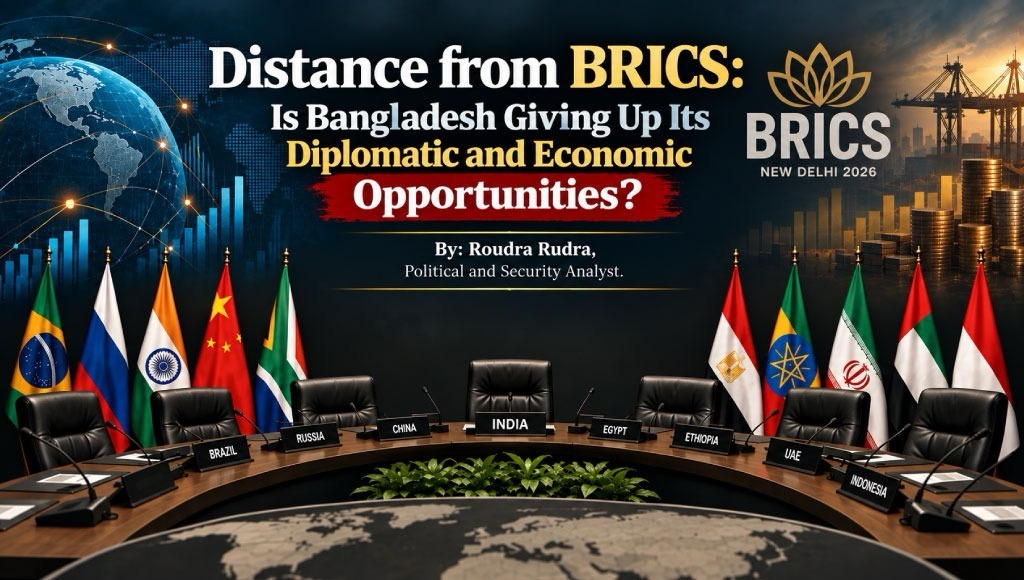
The 18th BRICS Summit is being held in New Delhi on September 12–13, 2026. Bangladesh is not a member of BRICS. However, as the current chair of BIMSTEC, Bangladesh was invited to participate in the summit’s outreach segment. In the end, Dhaka chose not to accept the opportunity, and Bangladesh will have no official representation at the summit.
The question is: Is this merely a matter of diplomatic protocol, or does it represent Bangladesh missing—and perhaps recklessly surrendering—an extremely important opportunity at a time when the global economic order is rapidly changing?
The Rise of BRICS in the Global Economy
The collective strength of the current BRICS members can no longer be ignored. According to 2026 data from the Government of India, the 11-member BRICS represents approximately 49.5 percent of the world’s population, 40 percent of global GDP and 26 percent of global trade.
The most tangible evidence of this strength can be seen in trade among BRICS countries themselves. In 2003, merchandise trade among BRICS countries amounted to only $84 billion. By 2024, it had risen to $1.17 trillion—an increase of nearly 13 times in two decades.
This is not merely a political grouping. It represents a rapidly expanding economic space encompassing markets, investment, supply chains and development financing.
Bangladesh Absent from BRICS Summit Despite Invitation
Bangladesh was invited to the outreach segment of the BRICS Summit in its capacity as chair of BIMSTEC. However, Dhaka declined the invitation. The government’s position was that the Prime Minister’s first visit to India should be bilateral and that the invitation was primarily extended to Bangladesh in its capacity as BIMSTEC chair.
But the question remains: If Bangladesh’s regional responsibilities created an opportunity to engage at one of the world’s most important economic platforms, should that opportunity have been allowed to slip away under the cover of protocol?
Attending the BRICS Summit does not mean becoming a member of BRICS, nor does it mean allying with any particular bloc. Rather, it would have provided Bangladesh with an opportunity to present its economic and strategic interests on the same platform as the leadership of major emerging economies, including India, China, Russia and Brazil.
Most significantly, despite their border and strategic disputes, India and China continue to use the BRICS platform together. On the sidelines of the 2026 summit, Narendra Modi and Xi Jinping also held talks, discussing trade, supply chains and border peace.
When major powers are using multilateral platforms to advance their national interests despite their differences, the question cannot be avoided: Why should Bangladesh, because of the current government’s arbitrary decisions, distance itself from such a platform?
Sheikh Hasina’s Foresight: Bangladesh’s Entry into the BRICS Economic Framework
Although Bangladesh is not directly a member of BRICS, it is a member of the New Development Bank (NDB), created by the bloc.
It is worth recalling that in June 2023, following a meeting between then-Prime Minister Sheikh Hasina and the President of South Africa in Geneva, Switzerland, Bangladesh formally submitted a “Letter of Interest” to join BRICS. Even before that, on September 16, 2021, Bangladesh had formally become a member of the NDB.
In other words, under the visionary leadership of then Prime Minister Sheikh Hasina, Bangladesh had joined an alternative development-financing framework whose founding members were Brazil, Russia, India, China and South Africa.
The significance of that decision has become even clearer today.
The NDB has already financed projects worth approximately $44 billion.
For Bangladesh, three projects had been approved by the NDB through the end of 2025, with total approved financing of $450 million.
This demonstrates that the decision taken during Sheikh Hasina’s government was not merely a symbolic diplomatic move. It opened a far-reaching alternative channel of foreign development financing for Bangladesh.
Protocol or Extreme Diplomatic Bankruptcy?
The government’s argument that the Prime Minister’s first visit to India should be bilateral may be a limited political consideration. But bilateral and multilateral diplomacy are not mutually exclusive.
For a developing country like Bangladesh, the real necessity is to utilize all available diplomatic platforms simultaneously.
When countries representing nearly half of the world’s population and around 40 percent of global GDP are gathering at one summit, dismissing the opportunity to engage on trade, investment, energy, infrastructure, technology and regional connectivity could have extremely serious consequences.
The New Reality of De-Dollarization
Within BRICS financial discussions, trade in local currencies, cross-border payments and alternative financial infrastructure are becoming increasingly important.
However, this should not simply be interpreted as “the collapse of the dollar.” No decision was taken at the 2026 summit to introduce a common BRICS currency. Instead, emphasis has been placed on increasing trade settlements and investment in local currencies, as well as advancing the integration of payment and messaging systems among member countries.
For an economy like Bangladesh’s, which is dependent on foreign currency and energy imports, these changes in international payment systems and access to affordable energy are extremely important.
Yet because of the current administration’s indifference and short-sighted policies, Bangladesh is increasingly becoming disconnected from these evolving global financial structures.
Missing Opportunities for Energy Security and Affordable Trade
BRICS countries include some of the world’s major energy producers and influential players in global energy markets. India and China have maintained their economies and industrial sectors by sourcing energy from Russia and Middle Eastern markets at competitive prices.
Yet by remaining absent from the BRICS Summit, Bangladesh is distancing itself from this emerging global network of potentially more affordable energy sourcing—further exposing the country’s already vulnerable energy security.
Trade with India: Not a Slogan, but a Harsh Reality
India’s importance to Bangladesh’s economy is most clearly reflected in the trade figures.
During the 2025–26 fiscal year, Bangladesh imported approximately $10.96 billion worth of goods from India. In contrast, Bangladesh’s exports to India stood at around $1.75 billion. This means the merchandise trade deficit was approximately $9.21 billion.
Given this reality, Bangladesh cannot sustain its economy by reducing relations with India to political emotion or the narrow protocol of bilateral visits.
Trade, energy, connectivity, borders and regional supply chains must all be considered together as part of a comprehensive national economic strategy.
Is Bangladesh Making Full Use of the NDB Opportunity?
This is where one of the current administration’s major failures becomes evident.
On one hand, the NDB has financed projects worth approximately $44 billion globally. On the other, by the end of 2025, only three projects had been approved for Bangladesh, with total financing of $450 million.
This suggests that the current administration is not merely distancing itself from the BRICS Summit; it is also failing to fully utilize economic opportunities secured by previous governments.
The scale of financing could potentially be expanded further for infrastructure, energy, transportation and climate-resilience projects. Yet, because of hasty and ill-considered policies, that potential remains largely unrealized.
A Multi-Alignment Foreign Policy Is in Bangladesh’s True National Interest
The central strength of modern diplomacy is not choosing one side while pushing everyone else away. It is keeping as many doors open as possible in pursuit of national interests.
India itself actively engages with a range of Western and Asian multilateral frameworks alongside BRICS. Even amid intense strategic rivalry between India and China, both countries continue to use the BRICS platform.
Bangladesh, too, needs this kind of pragmatic diplomacy—maintaining balanced relations with India, China, Russia, the United States, the European Union and the wider Global South.
Engaging more closely with BRICS does not mean taking a position against any particular bloc.
One Summit—or the Loss of a Major Opportunity?
It would be wrong to dismiss Bangladesh’s absence from the BRICS Summit as merely a routine diplomatic distance. It is a major indication of what can be described as the current administration’s arbitrary and potentially self-defeating policy approach.
As the world rapidly moves toward a more multipolar economic system, Bangladesh risks becoming one of the biggest losers on the global stage by voluntarily narrowing its own opportunities because of diplomatic protocol and political insecurity.
If this self-imposed isolation continues, Bangladesh could increasingly fall behind the evolving global economy, placing the country’s future development and economic stability in the face of a deep and potentially irreversible crisis.
In the long run, the cost of such isolation could be extraordinarily high—and the entire nation may ultimately be forced to pay that price.
By Roudra Rudra, Political and Security Analyst