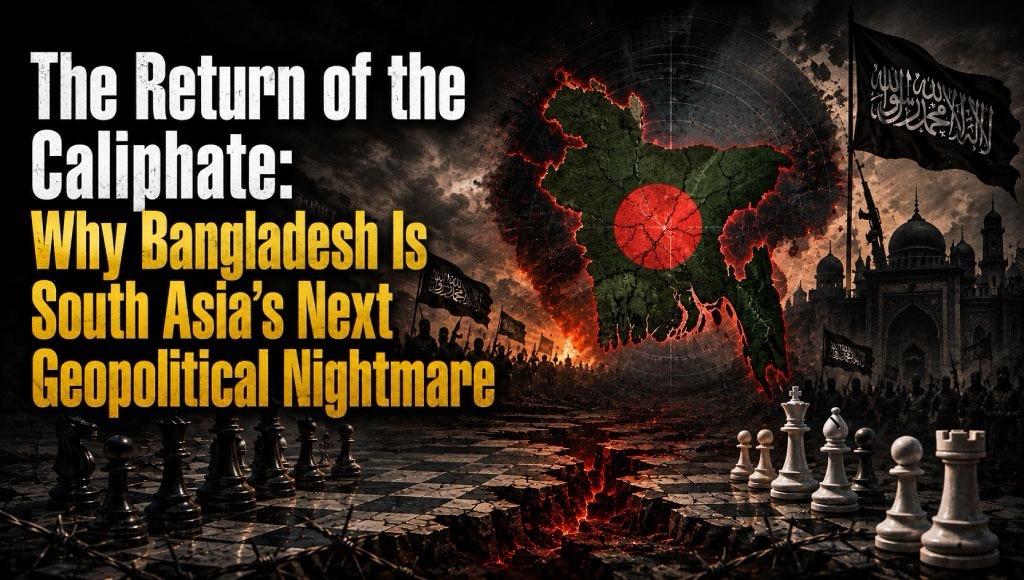

The international community stands willfully blind to a geopolitical catastrophe unfolding in South Asia. What was once celebrated by Western commentators as a Democratic Transition in August 2024 has metastasized into the systematic Talibanization of Bangladesh. On August 5, during a press briefing, Sajeeb Wazed Joy, Son and ICT Advisor of Former PM Sheikh Hasina, delivered an indictment that global intelligence agencies can no longer afford to ignore: “Bangladesh is not becoming Pakistan; it has already become Pakistan over the last two years.”
Is Islamic Extremism Taking Over Bangladesh?
Is Bangladesh becoming ‘another Pakistan’ on India’s east?
This was not rhetorical hyperbole; it was a precise autopsy of state collapse. Under the combined negligence of the former interim authority and the newly installed BNP administration, Bangladesh has effectively dismantled its secular state framework. It has surrendered its counter-terrorism machinery, embraced militant elements, and opened its borders to Islamabad’s security apparatus.
Is Bangladesh becoming another Pakistan?
The Post-2024 Security Collapse & Radical Re-emergence
Within days of the 2024 regime change, groups that had been driven underground for more than a decade reappeared in broad daylight.
- Hizb ut-Tahrir, banned since 2009, staged a “March for Khilafat” in Dhaka in March 2025, with thousands chanting for an Islamic caliphate at the national mosque.
Bring back Khilafat: Banned Islamist organisation marches in Bangladesh
- Jamaat-e-Islami and its student wing, once legally crippled, returned to formal politics with unprecedented strength.
- Neo-JMB, the local ISIS franchise, has been linked by investigators to at least 11 incidents since a December 2025 madrasah explosion in Keraniganj, bomb attacks on temples, police checkpoints, intelligence officials, and the recovery of grenades, pistols, and pressure-cooker bombs.
Keraniganj madrasah head made bombs overnight before explosion
Ansar al-Islam (Ansarullah Bangla Team) and other outfits have similarly regrouped. The United Nations Security Council’s Analytical Support and Sanctions Monitoring Team has explicitly warned that Al-Qaeda in the Indian Subcontinent (AQIS) is attempting to establish cells in Bangladesh, citing the country’s growing utility as a logistics and recruitment base.
This radical resurgence did not occur in a vacuum. Key counter-terrorism structures, including the Counter Terrorism and Transnational Crime (CTTC) unit, were deliberately neutralized or restructured. The result was a catastrophic breakdown of law enforcement after August 2024. Widespread prison breaks and large-scale desertions from the security forces allowed dozens of convicted terrorists and high-profile jihadist operatives to walk free and return to the streets.
Surveillance eases as extremists seek to regroup
Law-enforcement sources privately acknowledge that surveillance of these networks collapsed almost overnight. The predictable consequences followed: systematic stockpiling of explosives, targeted attacks, and a pervasive climate of impunity. Ordinary Bangladeshis now live with a grim reality: the same groups responsible for the 2016 Holey Artisan massacre and earlier waves of bombings have been handed a second chance by both the interim government and its BNP successor.
‘Neo-JMB Bomber Mamun’ Released After August 5 Now Named as Mastermind by Police
The War on Pluralism
Sajeeb Wazed Joy’s warning that Bangladesh has already become “another Pakistan” finds its most chilling evidence in the systematic war now being waged against the country’s pluralistic fabric. What is unfolding is not sporadic unrest; it is an ideological purge that closely mirrors the darkest chapters of state-enabled Islamization in South Asian history.
Systemic violence against minorities has become routine. Thousands of documented incidents of mob attacks, arson, property destruction and land grabs have targeted Hindu, Buddhist and Christian communities. Under the BNP government, meaningful prosecutions remain almost non-existent.
The assault on Sufi Islam has been particularly ruthless. Mobs driven by hardline Wahhabi-Salafi doctrines have systematically attacked and desecrated historic Sufi shrines (mazars) across the country in a deliberate attempt to erase Bangladesh’s centuries-old syncretic tradition. In the first 17 months after August 2024 alone, at least 97 Sufi shrines were attacked; three people were killed and hundreds injured. Mobs have looted, burned, and in some cases even exhumed and desecrated graves.
97 shrines attacked after uprising, 3 die, 468 hurt
Public and female spaces are being steadily erased. Extremist pressure groups have forced the cancellation of women’s national athletic competitions, pushed for radical changes in school curricula, and intimidated journalists into near-total silence.
Online radicalization has exploded in parallel. Subscriptions to extremist-linked channels surged from a few million in 2020 to more than 30 million by mid-2025, creating a vast digital pipeline for recruitment and ideological indoctrination.
This is not random mob violence. It is ideological cleansing. Sufism, once central to Bengali Islam, is now treated as heresy. Secular culture, women’s rights, and religious minorities are systematically targeted. The average citizen, whether a Hindu shopkeeper, a Sufi devotee, or simply someone who refuses the new orthodoxy, now lives with a profound and permanent sense of insecurity.
Bangladesh’s increasingly hardline religious currents pose deep social challenges
Joy’s diagnosis was not an exaggeration. It was a precise description of a country that has abandoned its pluralist foundations and is rapidly adopting the extremist blueprint long associated with Pakistan.
The Political Cover: BNP’s ISI Links and Government Indifference
Parallel to the internal radicalization has been a conspicuous and rapid warming of ties with Pakistan, an embrace that raises serious national security questions.
Visa-free exemption: The Advisory Council approved mutual visa-free entry for diplomatic and official passport holders from Pakistan, effectively dismantling security protocols carefully established after the 1971 Liberation War.
Bangladesh removes visa requirement for Pakistani officials for 1st time since 1971
Student exchange pipelines: More than 3,800 Bangladeshi students applied for higher education programmes in Pakistan this year alone under expanded exchange agreements, creating direct and largely unmonitored channels that can facilitate ideological radicalization.
Pakistan, Bangladesh discuss boosting educational cooperation
Unmonitored routes and presence: Direct commercial sea routes between Karachi and Chattogram have been reopened, while Pakistani cultural figures and corporate entities now visit with increasing frequency.
These soft-power exchanges are presented as harmless cultural diplomacy. Yet in a country where Neo-JMB operatives and AQIS networks are actively regrouping, a legitimate and urgent question arises: what guarantees exist that consignments, student exchanges, or cultural visits are not being used as cover for the movement of weapons, explosives, or operatives? History offers no comfort. Pakistan’s intelligence agency has a long and documented record of exploiting cultural and educational channels for influence and operational purposes.
Tarique Rahman, now at the centre of power, is not an innocent bystander. Long-standing allegations, some dating back to the 2001–2006 BNP years and strongly revived in 2024, have linked him to contacts with Pakistan’s ISI, including reported meetings in the Gulf. Whether every specific claim is fully proven or not, the pattern of indifference is unmistakable. Under his leadership, the state has shown almost no urgency in confronting the extremist resurgence.
Tarique Rahman in league with ISI?
Sajeeb Wazed Joy put it bluntly: foreign intelligence agencies, “especially the ISI, have an open hand” in Bangladesh today. The BNP’s historical accommodation of Islamist forces makes this silence unsurprising and deeply dangerous.
Here’s how this BNP leader hatched a plot with ISI to end Hasina’s Bangladesh reign
A Direct Threat to Global and Regional Security
International stakeholders, India, the United States, the European Union, and multilateral institutions can no longer treat this as an internal political transition. A Bangladesh that functions as a permissive environment for Neo-JMB, Hizb ut-Tahrir, Ansar al-Islam, and AQIS is not merely a domestic tragedy. It is a strategic liability for the entire region.
Sajeeb Wazed Joy’s statement was not hyperbole. It was a diagnosis. Bangladesh has already become Pakistan. The only remaining question is how much further the transformation will be allowed to go, and at what cost to the security of ordinary people and the stability of South Asia.