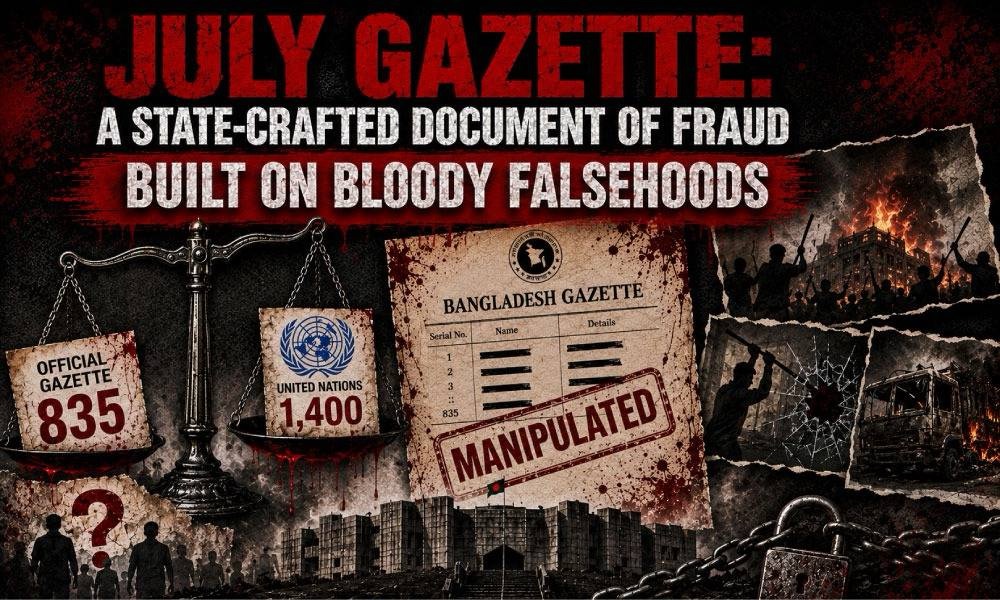

The official gazette says 835. The United Nations says 1,400. Where are the names of the more than 500 people in between? Who were they? What are their identities? Eighteen months have passed, yet these fundamental questions remain unanswered. Instead, as the deaths of many individuals listed in the gazette are being uncovered, the revelations are becoming increasingly alarming. What was supposed to be a list of martyrs has instead become a political weapon, mixing together people who were burned to death while looting with those who were killed in internal political clashes.
The government’s official gazette includes the name of Selim Reza, a schoolteacher from Bogura. Although he took part in the Anti-Discrimination Movement, he was not killed by the police. Instead, he was beaten to death with iron rods and hacked with sharp weapons by fellow protesters. Nevertheless, the blame for his murder was placed on Sheikh Hasina and the Awami League, with 101 Awami League leaders and activists named as accused in the case. His name appears as No. 518 in the Martyrs’ Gazette.
Similarly, Sohel Ahmed, Abdus Salam, and Selim Mondal, who had gone to carry out interior decoration work at a Dutch-Bangla Bank branch in Narayanganj, also appear in the gazette. Protesters set fire to the building while targeting a police barracks on the upper floors. These three workers were burned alive in that fire. Yet responsibility for their deaths was also attributed to Sheikh Hasina. They were listed in the gazette as Nos. 442, 485, and 526. Eleven months after the incident, a murder case was filed alleging that Abdus Salam had been “shot dead,” even though his own relatives maintain that he died after being burned in the fire.
Then there is Abdul Majid, a teenage truck helper from Chattogram. Having taken the job to support his impoverished family, he was burned alive inside the truck after protesters erected a barricade and set the vehicle on fire. He appears as No. 38 in the gazette. His death, too, was blamed on the Awami League.
The incident at Jabir International Hotel in Jashore starkly illustrates how looters were turned into “martyrs.” On 5 August, miscreants from a victory procession attacked the 16-storey luxury hotel. Looting took place from the basement up to the 14th floor, accompanied by alcohol consumption. Afterwards, another group set fire to the lower floors. As a result, 23 looters trapped on the upper floors were burned to death. An Indonesian national also died in the fire. Those same 23 individuals all found places in the Martyrs’ Gazette, including Rokonuzzaman Rakib (No. 29), Shawant Mehtab (No. 30), Tarek Rahman (No. 31), Alamin Biswas (No. 32), and Abrar Masnun Neel (No. 69), among others. Although local reports identified 24 deaths, the names of eight more individuals have since emerged who were not even included in the gazette. Awami League, Jubo League, and Chhatra League leaders and activists are being arrested in connection with cases over looting and arson. Yet it is no secret who carried out the attack, looting, and arson at the hotel.
This is the reality. The very gazette being relied upon places terrorists involved in looting, innocent people killed during the protests, and individuals murdered by criminals all into the same category. Meanwhile, the Office of the United Nations High Commissioner for Human Rights (OHCHR) continues to cite the figure of 1,400. On what evidence? Based on whose reports? Rumours of bodies floating in rivers and claims of mass graves—none of which have been substantiated—were amplified and promoted internationally. To this day, the United Nations has failed to produce any names, identities, or evidence supporting the figure of 1,400. It cannot do so, because that number is alleged to be imposed, fabricated, and politically motivated.
Yet it was on the basis of this disputed figure that Bangladesh’s elected government was overthrown. According to this account, the nationwide unrest that erupted in July 2024 was orchestrated with foreign funding, support from Islamist militant groups, and the silent backing of the military, allowing Muhammad Yunus and his associates to seize power through what is described as a staged political process. The BNP and Jamaat-e-Islami are described as beneficiaries of that power-sharing arrangement. It is now July 2026, and the BNP is fully in power. Yet not only has there been no accountability for the alleged fabrication surrounding the July Gazette, the uncertainty over the identities of the so-called martyrs, and the reliance on what the article describes as a baseless UN report, but there has also been no meaningful attempt to investigate these issues.
The question is now straightforward. If the United Nations genuinely cares about human rights, then it should present evidence supporting the figure of 1,400. It should publicly disclose the names, identities, locations of death, and circumstances surrounding the deaths of the remaining more than 500 individuals. If such evidence does not exist, then it should acknowledge that the entire narrative was a manufactured propaganda campaign. Likewise, those who prepared what the article describes as a false gazette and turned it into a tool for domestic and international conspiracies should also be held accountable. But the question remains: in this alleged July conspiracy, where separating the fraudsters would require uprooting the entire field, who will be the one to bell the greedy cat?