
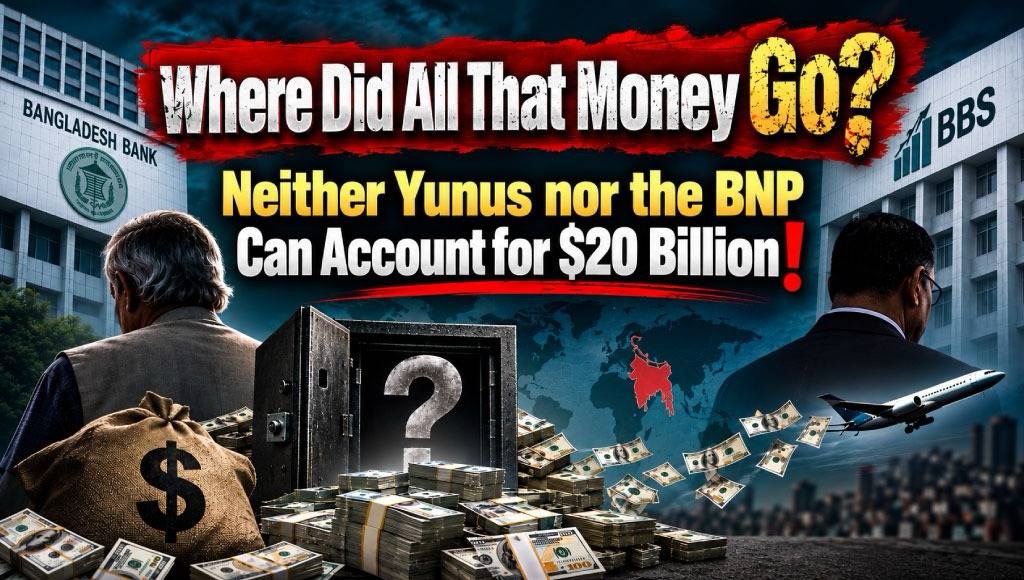

$20 billion! Just hearing the figure is enough to make your head spin. Yet there is no consistency even between the data provided by two government agencies regarding this enormous amount. Bangladesh Bank says one thing, while the Bangladesh Bureau of Statistics (BBS) says another. In the middle of it all, $20 billion appears to have simply vanished, raising questions about possible capital flight and money laundering.
This is not just an ordinary discrepancy in accounting. It is evidence of institutional failure that has continued for years. When the Yunus government was in power, it talked day and night about reforms, yet it could not even ensure minimal coordination between the central bank and the national statistics bureau. With so many advisers and task forces, how could such a massive gap remain in the country’s economic data?
And now the BNP government has come to power and appears to be continuing the same drama. There is no accountability, no investigation—only one report after another, while the government sits on the sidelines as a silent spectator. There is supposedly even a dashboard for monitoring LC payments, yet it is not being properly used. So much money is flowing out of the country, while those responsible for preventing it are busy with other calculations.
Ordinary people suffer when the dollar becomes more expensive. They suffer when the prices of essential goods rise. Yet those entrusted with running the country cannot even account for $20 billion.
The only difference between these two governments is when they occupied the seats of power. When it comes to irresponsibility, they stand in the same line.
And then, of course, there is the bigger question:
Who got how much of that money in their pockets?