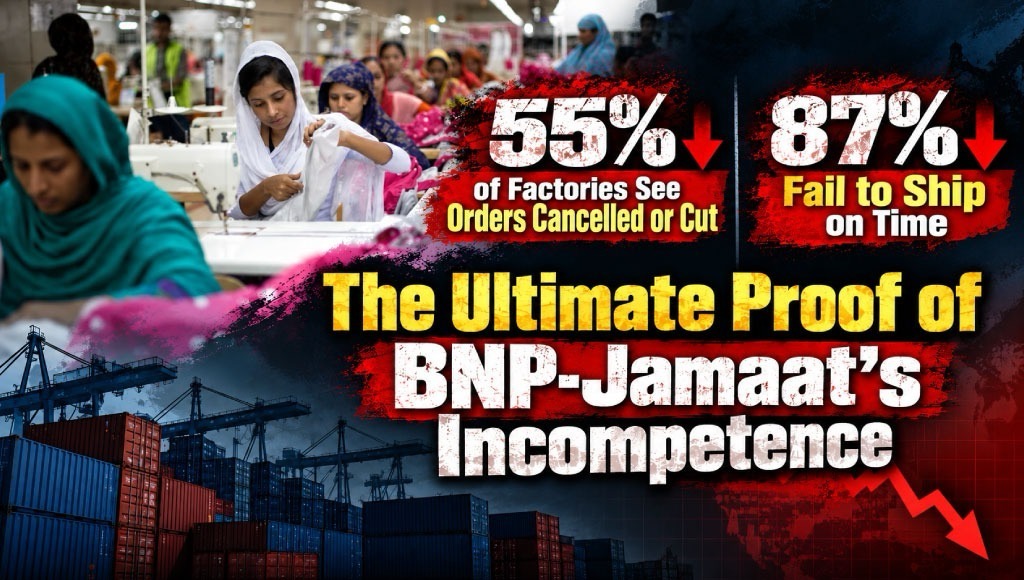

Standing in September 2026, it is now clear that the BNP-Jamaat government has failed to provide any evidence of industry-friendly governance. The latest survey by the Bangladesh Knitwear Manufacturers & Exporters Association (BKMEA) bears testimony to this. The gas crisis that began on July 20, followed by the power crisis, has dealt a severe blow to the knitwear sector. Export orders have been cancelled or reduced for 55% of factories, while 87% of exporters have failed to make shipments on time. These figures are a clear indication of state neglect.
The survey covered 20% of BKMEA’s 800 active members, meaning 160 factories. Of the surveyed factories, 75% were affected by the gas shortage and 90% by the electricity crisis. Gas pressure has fallen 78% below normal levels. Where is the government’s plan to meet this basic requirement of industrial production? Where is its commitment to ensure gas supplies for power generation? There are no answers.
The chain reaction triggered by the crisis has been devastating. Some 92% of factories have had to spend additional money on alternative fuels, directly increasing production costs. At 92% of factories, working hours have been lost—meaning workers have had fewer hours of work and potentially lower earnings. Some 89% of factory owners are at risk of losing the confidence of foreign buyers, posing a serious long-term threat to Bangladesh’s export reputation. Production has been partially suspended at three-quarters of the factories, 60% of owners face the risk of loan default, and 7% of factories have shut down completely.
For three decades, Bangladesh’s ready-made garment industry has been a major driver of export earnings. If this sector collapses, the consequences will extend to foreign-exchange reserves, employment, women’s economic empowerment, and the broader economy. Yet the BNP-Jamaat leadership has shown the greatest degree of neglect toward this sector. During the dark period of 2001–06, industries similarly suffered from shortages of gas and electricity, while workers took to the streets. Instead of learning from history, the country is once again being pushed in the same direction.
What has emerged from the BKMEA survey is a consequence of what is being portrayed as BNP-Jamaat’s anti-industry policies. At a time when foreign buyers are cutting orders and demanding discounts, the government’s responsibility was to provide a concrete roadmap for ensuring reliable energy supplies. That responsibility has not been fulfilled. Instead, the government’s silence and lack of effective response have become increasingly apparent with every crisis.
This crisis is not merely a matter for factory owners; it concerns the livelihoods of millions of workers. As the export sector approaches the brink of severe disruption under BNP-Jamaat’s governance, the suffering of ordinary people cannot be concealed behind political statements. The record of this alliance’s approach to industry and commerce remains deeply contested, and the current crisis has once again brought those concerns to the forefront.